Moltkeplatz (Moltke Place) is about 100m wide and 450 m long. Standing in Moltkestr. one can see a footpath on the left side and a traffic calmed cobbled street leading down to Kronprinzenstr./Ruhrallee. Old trees (probably some 60 years old, I doubt that any tree in Essen survived the war or the winters after the war) offer comfortable shadow.
Starting our trip round Moltkeplatz at the corner of Moltkestr. and Moltkeplatz we see the former Koppers Villa as the first building (Heinrich Koppers, 1872-1941, engineer for coking plants, petrochemicals). This villa was built by Oskar Schwer in 1911. The architectural style is called Reform-Architektur. Today, the International School Ruhr has its offices and rooms in the building ( http://www.is-ruhr.de ). The villa is protected as an historical monument. Right opposite in the middle of the place we find a lawn with some benches. There is a large green pipe coming out of the ground. This is not a piece of art. Instead it is a vent pipe of a former bomb shelter. You can find the counterpart on the other side of Moltkestr at the left side of the lawn where you can see the walled up entrance of the shelter.
Now walking down into the direction of Ruhrallee we pass a few newer apartment buildings which do not disturb significantly. Opposite these building the Tennisclub TC Schellenberg owns six tennis courts and a humble club house. This club is more then 80 years old. Wether this place was their home from the beginning on I would not know but I do remember that people play tennis here for more than 50 years.
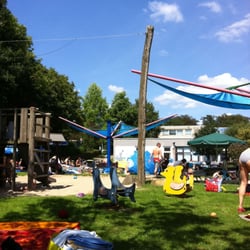
We carry on and pass some typical 80s-buildings. Opposite there is a small children's playground with sand, slide and ropes to climb on.
Some typical 60s-buildings follow, opposite people can play football on a small field.
Right behind the corner Moltkeplatz/Semperstr. we see the church of the Lutherian Community Essen. The church was built in 1911 by Otto Barting and is protected as an historical monument. In the middle of the place we find another lawn, a parking lot and the outdoor area of the Haus Wilmes Restaurant. In summer it is a nice place to sit and have a coffee.
The buildings Moltkeplatz 3-15 follow on our tour round Moltkeplatz. These buildings are not protected as historical monuments. I assume they were destroyed and rebuilt after the war. No. 5 is a bit different from the other buildings: the garden in front of the house looks rather individual with a bronze stele by Jo Schöpfer and the front wall of the building shows Katja Hajek's work Blaues Pigment = Blue Pigment. Opposite on the large lawn we can see some pieces of modern art ( http://www.kunst-am-moltkeplatz.de ).
Moltkeplatz No.1 is an 8 story building of no significance at all.
Going back and upwards on the footpath with its high plane trees we pass the modern art works, the Haus Wilmes Restaurant and the tennis courts. We are standing on Moltkestr. again and see the lawn in front of us and the Moltke Bridge on the righthand side. To the left we can see the huge building of the Robert-Schmidt-Vocational School. We look back and realize: at Moltke Place we can walk and walk the dog, relax and calm down, skate, have coffee or lunch or dinner, play football, climb ropes, watch tennis and touch art. There might be worse places in Essen
OY!!! So you found a mistake and now you think you can correct me, ha???
And you are perfectly right! Any comment on grammar and style is highly appreciated!! read more