First of course some history:…read more
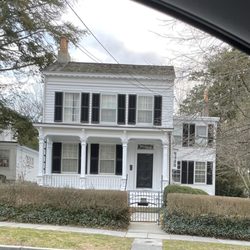
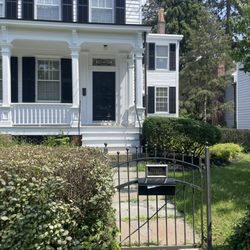
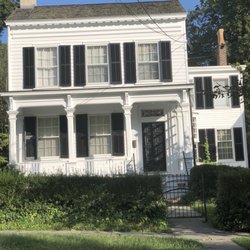
Hope Lodge was completed in 1748 by Samuel Morris who was a wealthy Quaker businessman. As a young man Sammy worked with his father at a mill complex in Ambler. Later he bought and sold commercial property in Philadelphia along with owning ships, a quarry, kilns, a tannery and Mather Mill which is only a block away from the mansion. As if that wasn't enough, Morris also had side hustles as being the justice of the peace for Whitemarsh, Philadelphia county commissioner and an assessor for Philadelphia county.
While Morris supposedly had never been to England, he adopted the most current architectural style of the day in both England and America, Georgian, named for King George I who was reigning at the time. The style was popular in Great Britain for its balance and symmetry. Fun rumor #1 is that Edmund Woolley, architect of Independence Hall, offered some advice on the mansion's design in exchange for some quarried lime and farm goods.
Now here's where the historic part comes in. In 1777 the Whitemarsh Encampment, a six-week period of the American Revolution when the Continental Army camped in the surrounding fields after the Battle of Germantown and before encamping at Valley Forge occurs. During that time the house was used as the HQ of George Washington's Surgeon General, John Cochran.
Fun rumor #2 is that while Washington never slept at the mansion or on the property, supposedly GW rode his horse through the first floor hallway of Hope Lodge during a visit. There is no evidence to support this claim, even though the hallway is wide enough, but no doubt that Washington would have visited Dr. Cochran frequently during the encampment.
Eventually everything gets sold to English banker Henry Hope. Hope, to give you a sense of his importance, has enough juice at the time that Adam Smith in the 4th Edition of his still read today economics masterwork The Wealth of Nations, dedicated the book to Hope. Also if the Hope family name sounds familiar it's because among other things the Hope Diamond was named after them due to their ownership of the diamond.
Never intending to live in Whitemarsh, Hope purchased the property as a wedding gift for his ward, James Watmough. It was the Watmoughs who named the site Hope Lodge, in honor of their benefactor. Prior to that and during Samuel Morris's lifetime the property is known as Whitemarsh Farms and Whitemarsh Estate.
The property is then sold to a family who for almost the next century uses it primarily for farming. Lack of funds prevented upgrades to more modern things gas lighting and indoor plumbing in the late 19th century which meant the mansion's 18th century integrity is retained.
From the Internet: "In 1921 the property is sold to Keasbey and Mattison, a development company whose plan was to demolish the structure and extend a nearby limestone quarry. To save it from destruction, William and Alice Degn bought the property in 1922. Early historic preservationists, they carefully restored the house and added their collection of 18th and early 19th century furnishings. They did not install a central heating system in the main house because of its destructive piping; rather they added a wing onto the existing summer kitchen for a winter residence. Both of the Degns loved flowers, and they created a beautiful rose garden on the south side of the house.
After Mr. Degn's death in 1940, and Mrs. Degn's death in 1953, ownership of the house was transferred to the Hope Lodge Foundation, and in 1957, to the Commonwealth of Pennsylvania. Today, Hope Lodge is administered by the Pennsylvania Historical and Museum Commission with the Friends of Hope Lodge, a non-profit support group formed to assist with operations at the site."
So what you have today is a house that does not have the historical gravitas of a place where a Founding Father lived, worked or slept but due to the love it has received particularly from the Degn's the actual bones of the house are in amazing condition with the feature being the incomparable woodwork.
If you go:
Hope Lodge is not unlike a lot of other PHMC sites in that you really have to want to see it. Tours are only done one day a month, usually the 3rd Sunday, at 1pm and 2:30pm. Some months offer special events like a symphony concert, beer tasting, movie night under the stars and the biggie which is the annual re-enactment of the 1777 Whitemarsh Encampment which takes place in November.
Tour admission is $5.00 for adults, $4.00 for seniors, $4.00 for youth age 6-17, children under 5 are free and Friends of Historic Hope Lodge members are free. Cash or check only. Active military personnel and their families are also free.
Parking is via two smallish lots one on the side of the property near the gardens and the other in the rear of the property. The property is on South Bethlehem Pike which is very easy to get to from both the PA Turnpike and Route 309.