Cancel

    Open app

    Search

    Maximiliansplatz Photos

    Maximiliansplatz Reviews in Other Languages

    Verify this business for free

    Get access to customer & competitor insights.

    Verify this business

    Altes Rathaus - Bamburg teas.

    Altes Rathaus

    4.7(14 reviews)
    0.4 km

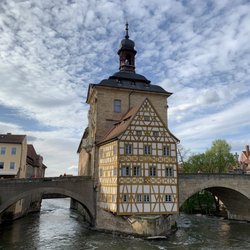
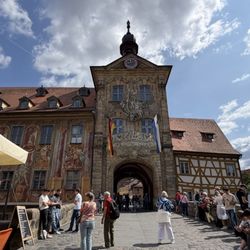
    The iconic Bamberg landmark. The Old Town Hall in Bamberg is one of the most important buildings…read morethat characterize the historic city center. It is located between the mountain and island town in the left Regnitz arm. This location "... marks the old rule border between the episcopal mountain town and the bourgeois island town and clearly shows the power striving of the Bamberg bourgeoisie." You see, the bishop of Bamberg did not want to give any of his land to the citizens for the construction of a town hall. Therefore, the crafty citizens struck stakes in the Regnitz and thus created an artificial island on which they built their town hall. The Regnitz marks the old rule border between the episcopal mountain and the bourgeois island town. The town hall was mentioned for the first time in 1387 and was rebuilt between 1461 and 1467, so that it took on the shape it is today. At this stage of construction, it was mainly influenced by the Gothic. Johann Jakob Michael Küchel redesigned the town hall between 1744 and 1756 in the Baroque and Rococo styles. Worth mentioning are the façade paintings originally created by Johann Anwander in 1755, which have been restored many times. After not much of these paintings could be seen in the 1950s, the painter Anton Greiner repainted between 1959 and 1962. Both sides of the building are completely decorated with simulated allegorical scenes and architectural details, the typical illusion painting of this time. Small, actually figurative elements on the eastern side reinforce the spatial impression. The Rococo balconies and coat of arms reliefs come from Jos. Bonaventure Mutschele. The half-timbered house attached to the bridge tower, the Rottmeister's house, served as accommodation for the leaders of the guards. You cannot miss this structure when/if you are in Bamberg. It's a must-visit place along with Bamberger Dom and Neue Residenz.

    Mitten über dem linken Arm der Regnitz thront das opulente "Alte Rathaus" Bambergs. Das von der…read moreGotik beeinflusste Gebäude entstand zwischen 1461 und 1467 und wurde im 18. Jahrhundert im Barockstil umgestaltet. Die schönen Malereien auf der Fassade stammen ursprünglich von Johann Anwander, mussten aber 1959-62 von Anton Greiner komplett neu gestaltet werden, weil die Originale verblichen waren. Auch die Neubemalung verblasst langsam. Die Brücke führt direkt durch das Rathaus, man gelangt hier in die eigentliche Altstadt. Architektonisch bemerkenswert ist das "Rottmeisterhäuschen", ein Fachwerkanbau auf der Seite, der fast so wirkt, als strecke das Rathaus seinen Hintern in Richtung Fluss aus. Es war ursprünglich ein Anbau für die Wachsoldaten. Dass Rathaus beherbergt ein wichtiges Museum, die Sammlung Ludwig: Es war die größte private Porzellansammlung in ganz Europa und wurde von den Erben der Stadt Bamberg hinterlassen.

    Photos
    Altes Rathaus - Bamburg teas

    Bamburg teas

    Altes Rathaus - Bamburg teas

    Bamburg teas

    Altes Rathaus

    See all

    Bamberger Dom St. Peter und St. Georg

    Bamberger Dom St. Peter und St. Georg

    4.7(31 reviews)
    0.6 km

    With more than 1,000 years of history, this cathedral is simply magnificent. A "Castrum Babenberg"…read moreexisted on the Domberg (Cathedral Hill) and was mentioned in 902 for the first time. It was founded in 1002 by King (and later crowned as the Holy Roman Emperor by pope Benedict VIII in 1014) Heinrich (Henry) II and consecrated in 1012. Emperor Heinrich II died in 1024, and his wife empress Kunigunde in 1040. With the tomb of the couple, the cathedral contains the remains of the only imperial couple that was canonized. The second bishop Suidger of Bamberg was elected as Pope Clemens II. in 1046. His last resting place in the Bamberg Cathedral is the only preserved tomb of a pope in Germany and north of the Alps. After the first two cathedrals burned down in the 11th and 12th centuries, the current structure, a late Romanesque building with four large towers, was built in the 13th century. The cathedral is about 94 m long, 28 m broad, 26 m high, and the four towers are each about 81 m high. It contains many works of art, including the marble tomb of the Emperor Heinrich II and his wife, the Empress Kunigunde, considered a masterpiece of the sculptor Tilman Riemenschneider, and carved between 1499 and 1513. Another well-known treasure of the cathedral is an equestrian statue known as the Bamberg Horseman (German: Der Bamberger Reiter). This statue, possibly depicting the Hungarian king Stephen I, most likely dates to the period from 1225 to 1237.

    Dominating the hillside above the old town of Bamberg is its imposing late Romanesque Cathedral…read more The current building is the third to stand on the site, after the original (founded by Heinrich II and his wife Kunigunde in 1104), and its successor, both burned down. Erected in the 13th Century, the style is a mixture of late Romanesque (particularly the doorways and windows) and early Gothic, best seen in the arcades. The exterior is dominated by four spires and some impressive sculpture in the porches: the interior has some lovely treasures - particularly the late Gothic tomb of its founders, Heinrich and Kunigunde, and the unusual but impressive equestrian statue of the Bamberg horseman. Sadly, the decision to strip away the plaster and wall decoration in the 19th Century does detract from the atmosphere: the bare expanse of stone could do with some colourful banners (or restored plaster and fresco) to enliven it. The cathedral has two crypts, one of which, containing saintly relics, can be visited. The west choir was roped off in my visit but contains the only papal tomb North if the Alps (that if Clemens II).

    Photos
    Bamberger Dom St. Peter und St. Georg
    Bamberger Dom St. Peter und St. Georg
    Bamberger Dom St. Peter und St. Georg

    See all

    Maximiliansplatz - landmarks - Updated May 2026

    Loading...
    Loading...
    Loading...