History
Studies conducted in 1937 by Rijkswaterstaat…read more(Department of Public Works), showed that safety in many parts of the Netherlands could not be guaranteed at times of storms and high sea levels. In the densely populated areas near the river mouths of the Rhine, the Meuse, and the Schelde, it proved very difficult to build new dikes or strengthen the original ones. The first solution was to close all the river mouths: the Western Schelde, the Eastern Schelde, the Haringvliet, and the Brouwershavense Gat. This proposal was christened 'the Deltaplan'. In 1950, the first river mouths of the Brieles' Gat and the Botlek were closed. The Brielse Maas became a freshwater basin. This not only made the area safer, but it also provided Voorne with a freshwater supply. The plan was to build the remaining dams in the following decades. Unfortunately though, the infamous flood of 1953 prevented this from happening. Nearly two thousand people died and more than 150,000 hectares of land were flooded. People soon became aware that something had to be done, and very, very quickly.
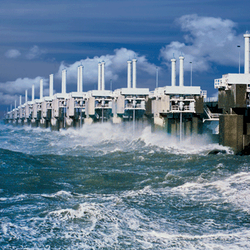
Twenty days after the flood of 1953, the Delta commission was inaugurated. The commission would give advice about the execution of the Deltaplan, that would, in the long run, increase the safety of the Delta area. Although safety was the number one priority, the seaways De Nieuwe Waterweg and the Western Schelde would have to stay open, because of the economic importance of the ports of Rotterdam and Antwerp. In order to be able to build dams in the rivers' mouths, some auxiliary dams would first have to be built in the Zandkreek, the Krammer, the Grevelingen, and the Volkerak. These dams were known as 'compartment dams', since they would divide the large area of water into multiple compartments. In 1959, the Delta Law was passed, in order to organise the construction of the dams. The building of the 'Deltaworks' was such an enormous project, that it was sometimes referred to as the 'eighth wonder of the world' - and not without good reason.
When you think about the Deltaworks, the first things which probably come to mind are steel and concrete. However, the people who built the Deltaworks did not simply place the heavy constructions on the bottom of the sea. With regard to the Oosterschelde, for instance, the bottom was so weak that specially made mattresses filled with stones had to be placed on the bottom. Geological research was required in order to find out more about the layers of the earth. Within the following pages of this section, you will find more information about geology in general, the geology of the Netherlands, and the geology of the Delta region.
The environment was very important too when considering the design of the Deltaworks. Some dams could only be closed during particular circumstances, i.e. when the tides and the winds were favourable. And you may almost forget: why were the Deltaworks built anyway? Exactly, because of flood disasters, caused by a combination of extreme weather conditions and spring tide. Knowledge of the weather and the climate is especially important when building something as large as the Deltaworks. The most advanced computer programmes were used to calculate the wind speeds and the currents, before the Maeslantkering and Oosterscheldekering could first be closed. Now the Deltaworks have been completed, research into (the change of) climates still has priority, since climate changes could have an effect on the sea levels. In the Netherlands, in which about half of the country lays below sea level, swimming is still a preferred solution to sinking.
Lastly, the Dutch landscape and some serious (global) environmental problems will be discussed. The Dutch landscape has been influenced particularly during the last two thousand years, since humans entered the area. Three prominent types of landscape will be described: the sea clay landscape, the river clay landscape and the dune landscape. Moreover, four environmental problems will be discussed: the rise sea level, the dangers to fish, the depletion of the ozone layer and water pollution. All these problems have (indirect) effects on us. It is not too late though and we can do a lot to help by treating our environment responsibly.