Cancel

    Open app

    Search

    Maria Hilf Photos

    Maria Hilf Reviews in Other Languages

    Verify this business for free

    Get access to customer & competitor insights.

    Verify this business

    Schwäbisch Hall

    Schwäbisch Hall

    5.0(3 reviews)
    42.2 km

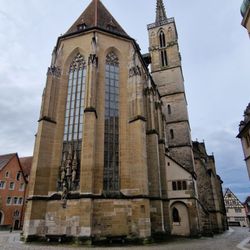
    Schwäbisch Hall or Hall for short was first mentioned in a document dating from 1063. It's…read moreunclear, but Hall possibly refers to the open-pan salt making method used there until the saltworks closed down in 1925. Salt was produced from brine by the Celts at the site of Schwäbisch Hall as early as the fifth century BC. Hall flourished through the production of salt and coins after imperial mint was founded by Emperor Frederick I Barbarossa. Hall became a Free Imperial City of the Holy Roman Empire around 1280. From the 14th to the 16th centuries, Hall systematically acquired a large territory in the surrounding area, mostly from noble families and the Comburg Monastery. The wealth of this era can still be seen in some gothic buildings like St. Michael's Church (rebuilt 1427-1526) with its impressive stairway (1507). The town joined the Protestant Reformation very early. Johannes Brenz, a follower of Martin Luther, was made pastor of St. Michael's Church in 1522 and quickly began to reform the church and the school system along Lutheran lines. Hall suffered severely during the Thirty Years' War (1618-1648) though it was never besieged or scene of a battle. However, it was forced to pay enormous sums to the armies of the various parties, especially to the imperial, Swedish and French troops. Between 1634 and 1638 every fifth inhabitant died of hunger and disease, especially from the bubonic plague. The war left the town an impoverished and economically ruined place, but with the help of reorganizations of salt production and trade and a growing wine trade, there was an astonishingly fast recovery. The Napoleonic wars brought the history of Hall as a Free Imperial City to an end. Following the Treaty of Lunéville (1801), the duke of Württemberg was allowed by Napoleon to occupy the town and several other minor states as a compensation for territories on the Left Bank of the Rhine that fell to France. Although Swäbisch Hall doesn't have any medieval fortifications walls surrounding it like Rothenburg o. d. T. or Dinkelsbühl, it certainly provides a very quaint medieval atmosphere with its numerous half-timbered houses and buildings, cobble stone streets, massive Gothic church on the hill, and Kocher River running through it. You can certainly enjoy strolling and wandering in this town for hours imagining how one's life might have been during those days. You'll enjoy visiting this town.

    Photos
    Schwäbisch Hall
    Schwäbisch Hall
    Schwäbisch Hall

    See all

    Königstuhl

    Königstuhl

    4.7(18 reviews)
    76.7 km

    Fun and reasonably priced way to see the city from the top! There are a couple funiculars depending…read moreon how far up you want to go, but I recommend going all the way up as the view is beautiful! There's a cute little bar/cafe at the top to enjoy the view. The castle is in the middle and interesting to walk around before heading back down to the city. Definitely a great experience in Heidelberg!

    While visiting Heidelberg, Königstuhl is a must-go attraction. Rightly called the King's Chair or…read moreThrone, it is a 567.8 meters high hill in the Odenwald Mountains. The summit allows visitors to overlook the city of Heidelberg and the Neckar River. The hilltop is the last stop on the Funicular Railway. Here, over 1,700 feet above Heidelberg, the visitor can catch a fantastic view of the region. But the view of the city is not the only reason to venture up there - there are numerous other sights as well. There is a falcon breeding station called Tinnunculus, a children's fairy-tale-themed park named Märchenparadies, and the Alter Kohlhof, a restaurant, winery, and hotel. The State Observatory of the University of Heidelberg is also located there. And in case that's not enough, there are numerous hiking trails for a bit of nature exploring. The sunset looks serene. Parking availability outside. A great place for families and kids. Going up and down with the train. Breathtaking view from the top. A perfect destination for trekkers, wanderers, and mountain bikers. Beautiful panorama. In a nutshell, it is an oasis of peace and relaxation, simultaneously offering a fantastic view of Heidelberg, the Neckar Valley, and the Rhine Plain.

    Photos
    Königstuhl
    Königstuhl
    Königstuhl

    See all

    Philosophenweg - Blick vom Philosophenweg auf die Alte Brücke 10.10.2010

    Philosophenweg

    4.8(42 reviews)
    78.3 km

    At first when you start the walk, it's a bit confusing because you feel like you aren't in the…read moreright place as you're walking up narrow alleyways near the Heidelberg University. Soon however, you'll realize that this is legitimately the best view of Heidelberg and may never want to leave. Highly recommend walking from the top instead of climbing up the stairs as the ascent is more gradual and not as tiring. Some of my favorite parts about the walk: - When you want to look at views, you want to look at all the important points of the city. So for example, in London you would like to see the Shard, London Eye, etc. The other place for notable views in Heidelberg is the Heidelberg Castle but its just not as interesting because you can't see the castle itself which is essential to the viewing experience. Therefore, Philsophenweg is fantastic because you are able to see everything important and notable in the city. - The walk is so relaxing and there are views throughout! - Lot of places to sit and take in the view and even on a weekend, there wasn't a crazy amount of people there. - I love how many wildflowers are growing in the area. Adds to the natural aesthetic and it seems almost like effortless beauty in a way. Overall, fantastic walk and I would highly recommend this as a first visit when you get to Heidelberg to understand all that the city has to offer.

    If you walk across the bridge and climb up a couple hundred steps to the philosopher's walk, you…read morewill be in awe. There are fantastic views and excellent photo ops of the Neckar River, Heidelberg, and the beautiful surrounding gardens. You will most definitely be craving a beer, but keep going! You will land on a path that is adorned with unusual trees and plants from the Mediterranean, North Africa and Asia, such as cypresses, bamboos, rhododendrons, gingko and yucca trees. I felt like I was in another world when I was up there. If you have time, and have caught your breath from the stairs, continue further up the mountain to capture even more treasures. From church ruins to a Nazi Amphitheater, you will be sure to find something of interest. There is also an old Celtic ring wall surrounding the top of the mountain. As you're walking, you will notice there are many different trails to choose from. Make sure to follow the arrows that point toward Heiligenberg if you want to hike to the sights I mentioned. It will take you about an hour to walk up. After capturing a hundred photos, burning off those bratwursts, and making new friends, you will be tuckered out. But, fret not, a pint of Spaten will be anxiously waiting for your arrival at the bar just beyond the Neckar River.

    Photos
    Philosophenweg - Altstadt, Neckar und Schloss - kurz nach Einbruch der Dunkelheit

    Altstadt, Neckar und Schloss - kurz nach Einbruch der Dunkelheit

    Philosophenweg
    Philosophenweg - Panorama - kurz vor Einbruch der Dunkelheit

    See all

    Panorama - kurz vor Einbruch der Dunkelheit

    Maria Hilf - landmarks - Updated May 2026

    Loading...
    Loading...
    Loading...