I was somewhat disappointed by our day trip to Chateau de Sarzay, as it had been talked up…read moreenthusiastically by a member of our party who had toured it previously. The thing is, Sarzay is a tiny little backwater town in the Indre Valley, and unless you are already there for other reasons, its a long drive from anywhere you are likely to be. Even though its very close to the geographic center of France, its really the sticks. We were staying in Tours, which is about 130 miles (2+ hours drive) away in the Loire Valley.
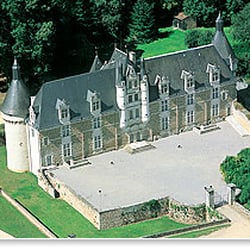
The castle is in what I would call an advanced state of disrepair. What remains is one of the buildings of the keep, a four-tower "pod" clustered around a single staircase, and a smaller auxiliary tower housing a chapel. I have read all the available material about its recent history, including its purchase and attempted restoration by Monsieur Hurbain, who along with his wife (I assume) are still the proprietors here. He explained that the main hall or keep is used for events these days (weddings apparently being their primary source of clientele), and there is a wing of that used as private apartments, which I believe is the rooms they rent. There is also a barn-like structure that appears to be used for storage and for catering events.
On to the castle; it looks as though restoration efforts were halted years ago, or at least, are now undertaken only in a haphazard, occasional, and lackluster manner. I cannot blame the man as he is now quite elderly, and its hard to imagine being capable of much strenuous labor or lifting heavy things at his age. But let's just say that his life's work is incomplete; there is so much to be done, I wouldn't even know where to start. That what remains is even still standing after 900 years or whatever it is, is of course impressive on its own.
There is a lot of disused construction equipment , everything from tools to solvents, paints, tiles and lumber in various rooms of the castle tower. There is very little curation of the decorations and what might be artifacts in the interiors. The first level contains an unusual number of stuffed animals ( taxidermy), and exudes an unpleasant musty/dusty odor - we left quickly, because it seemed an unhealthy place to linger, in addition to being a bit creepy. However, ascending to upper floors revealed even more Hitchcockian weirdness, as we discovered some of the rooms to be filled with wedding gowns in various states of preservation. One level had a room with tables of iron weapons - halberks, axes, swords, even a flail. Some of the rooms have been "furnished" but not all of the furniture is "period correct"; one four poster bed was clearly of modern origin and dimensions, with a Sealy mattress in it. The top level of the tower has a wood floor dotted with pigeon droppings, and a series of wooden ladders penetrating the trusses, beams, and braces that support the exterior roof. We did not ascend these ladders, as I had doubts about their sturdiness and felt that being exposed to a room full of bird droppings, without a mask, was a good way to contract a variety of illnesses with which I would not want to be afflicted in a foreign country far from a decent medical system.
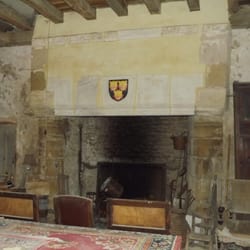
On the plus side, you do get a sense for what life in such a tower would have been like. The bigger rooms were clearly for the lords or his "upper management" staff, while each main room has a smaller room, which was likely used for a sleeping alcove for children or servants. The main rooms each have a fireplace, which would have been used both for heat and meal preparation. All rooms are accessed the same way , via stone steps cut into the tower in a spiral staircase fashion. The lintels are low (at 5'10" I cracked my head on a couple until I learned to stoop more deeply).
There is a smaller tower which contains a small chapel with a one room "apartment" above it, which can be accessed via a wood staircase with no handrail; ascend this at your own peril, as the stringer of the staircase is riddled with dry rot. To mitigate the risk, we went up one person at a time.
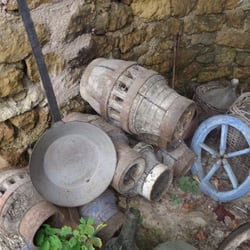
(I have to say, in the US, such a thing would never be allowed open to the public. There is also a cistern on the property that rather than a proper safety grate just has a rusty wagon wheel placed over the top (even a determined child could push this aside and manage to gain access); the opening is about four feet above ground, but still, a possible hazard as its an attractive nuisance. )
The moat, which Hurbain apparently dredged and refilled is a mostly stagnant mucky looking thing with ducks and geese in it. At first I thought the stench in the courtyard was coming from this miserable ditch, but it turned out that just on the other side of the low stone wall that buttresses the interior edge of the moat, they've got a pigsty. The smell was unbelievable.