Cancel
Open app
Search
Sign Up
Log In
Nearby
Bookmarks
Start a Project
Add a Business on Yelp
Add Review
Call
Directions
Website
+20
Start your review...
Get app
9 years ago
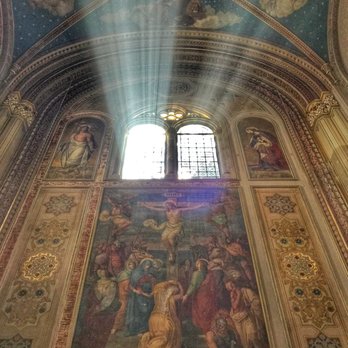
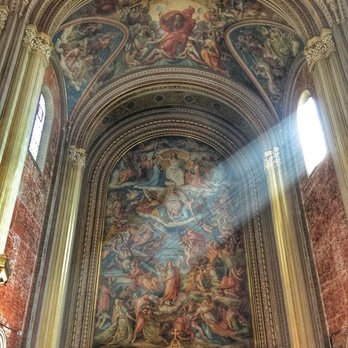
The frescos inside Ludwigskirche are truly amazing. I had not seen in marketed as one of the key sights to see in Munich, but it is definitely well worth a visit. read more
See all
Ludwigstr. 20
80539 Munich
Germany
Maxvorstadt
089 288334
Call Now
Visit Website
http://www.st-ludwig-muenchen.de
Hours
What time does Ludwigskirche open?
What time does Ludwigskirche close?
German
5 Reviews
Get access to customer & competitor insights.
More beautiful architecture thanks to Roman Catholic influence!…read more This is a beautiful church. We didn't climb to the top, because it cost money and wasn't part of the "free tour". We didn't stay for a service, but came in time to hear the church bells!
The church interior is spectacular and you must see the jewel decorated skeleton of St Munditia who…read morewas murdered in 310AD, the decorations were added to the remains in 1675. Also ascend the stairs to have views of the central plaza including the Glockenspiel and Rathaus, and the Frauenkirche.
Side Aisle at St. Peter's Church
Seitenaltare
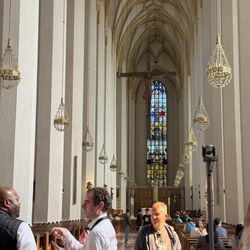
Such a historical landmark that is worth visiting. The high ceilings are amazing to view…read more Take a few minutes to soak in the atmosphere and the incredible architecture.
Stomp of the devil to help pay to build the church. The devil didn't want windows in the church so…read morepeople won't come pray. People came anyway and made the devil mad so he stomped on the church and left his imprint
... Abendstimmung ...
This place is a beautiful find. It is sandwiched between shops in the area.. The architecture is…read moreexquisite and detailed. I lit a candle ( for a fee) and just said a prayer for late loved ones.
Beautiful church that sorta blends in with the surroundings in the outside but is absolutely…read morestunning and ornate in the inside. The visuals are amazing and you can get a sense of the splendor of when it was built.
Restaurierung.
It's pretty hard to put into words how stunning this church is. We were wandering around…read moreMarienplatz and walked in here after noticing the beautiful building. The interior of this church is incredible, and is worth taking your time to check out all of the details. There were also many sitting at the pews praying or taking in all that there was to see. Make sure not to skip this sight in Munich!
The beautiful Church of the Holy Ghost is located between the Town Hall and the large…read moreViktualienmarkt in the very centre of Munich, but easily overlooked by visitors. Founded in the 13th Century alongside a hospital for lepers and the lame, the first Church burned down; after some 60 years, the core of the present building was completed in 1392 in the gothic style. However, like many Bavarian churches of the period, it was completely remodelled inside in 1724-30 in the Baroque style, in this case featuring frescoes by the Asam brothers (who built the nearby Asamkirche), although the essential Gothic structure is easy to work out beneath the stucco. The frescoes depict the history of the hospital, which was demolished in the late 19th Century to make way for the market. Well worth a quick detour to visit.
Heilig Geist Kirche
Seitengang
We really enjoyed visiting this beautiful historic church in the Old Town area of Munich. The…read morecrypt below is definitely worth exploring too as it is the final resting place of many members of the Bavarian royal family from the 16th to 20th centuries. The Church itself is an amazing sight inside and with artistic and religious treasures all around. Its also a great place to worship and much less crowded with tourists than the Frauenkirche nearby.
This huge renaissance church, completed in 1597, is famous for its huge barrel-vaulted roof and as…read morethe burial place of King Ludwig II and his brother, King Otto. The Church was commissioned by William V, Duke of Bavaria, as a centre for the Counter-Reformation, and a base for the Jesuits, who were already established in Munich. Building began in 1583, but the church itself had to be partially rebuilt after the tower collapsed through the choir in 1590: ironically, it was the huge vault - then the widest after St Peters in Rome - that people feared would fall. Rebuilding began immediately with a new choir and large transept, and an elaborate facade with statues depicting the lineage of the Bavarian Royal Family. It's early baroque style influenced many other churches, but it also incorporates many motifs of the Counter-Reformation within its decoration: the transept vaults appears as triumphal arches, and the bronze statue of St Michael on the main facade shows him fighting a humanoid devil - often taken as an allegory of fighting for the faith against the Protestants. Badly damaged in World War Two, it's restoration was completed in 1983. It remains one of the largest renaissance churches, north of the Alps. King Ludwig II and his brother King Otto are buried in the crypt, alongside other Wittelsbachs. Access to this is via stairs in the south (right-hand) transept. There's a fee of €2, but they don't accept small change and photography is not permitted. I don't mind that, or paying a fee, but the person taking the money had to the least welcoming and grumpiest individual in Munich. Not much of a Christian welcome, I'm sad to report.
High Altar
One of many Side Altars
The Marion Congregation was founded in the early 1900's and Fr Rupert Mayer the founder was well…read moreknown for his open stand against the nazi regime. He spoke out against anti-Catholic baiting campaigns and fought against Nazi church policy. Fr. Mayer spoke from the pulpit of St. Michael's in downtown Munich and because he was a powerful influence in the city, the Nazis could not tolerate such a force to oppose them. On 16 May 1937, the Gestapo ordered Fr. Mayer to stop speaking in public which he obeyed, but he continued to preach in church. He ended up in jail on numerous occasions as a result of his stand. It is an ordinary looking building from the outside but when you step in its beautiful. Nice ornate walls and ceiling and very peaceful. It was my first visit here and I was delighted we stepped in for a peek.
Looks like a regular house from the outside, but inside is a fantastic double church. Upstairs, a…read moreBaroque beauty which usually has a mix of faithful praying and tourists in awe wandering the pews. And downstairs, where the "Apostle of Munich" and Anti-Nazi Preacher, Blessed Rupert Mayer lies, a vaulted, cavernous "lower" church. Thousands of people visit his grave and pray in the chapel every year. A sight to behold that blends history, architecture and contemporary life in Munich in a unique way.
Attended Catholic Sunday Mass at 10:15am at the Basilica of St. Boniface (aka St. Bonifaz). Turns…read moreout it was the Children's mass. The priest did such a good job with the kids. It was a fun, engaging mass, really designed for the kids. The altar and seating are for a mass in-the-round, seating is a full circle around the altar. Church was consecrated in 1850 and is attached to the Benedictine abbey. It was heavily damaged and rebuilt. Very friendly setting. Church is close to the train station, The Charles Hotel (thank you, concierge), and the botannical garden in central Munich. We did not tour the Abbey itself, which looks beautiful from pictures on the internet. But the church is very good for mass for kids, if you go to the Children's mass.
Basilika St. Bonifaz, Außenansicht
Beautiful church in Munich! Definitely worth checking out and in the main part of town.read more
Don't miss it when in Munich and read other reviews for an opinion. I just love old Bavarian…read morechurches and the colourful interiors in them :-)
This charming little church is tucked away close to the tram route along Müllerstrasse, not far…read morefrom the Sendlinger Tor. The Church, dedicated to St. Stephen, is the former cemetery church of the old South Cemetery of Munich. The church is a branch church of the Mother Parish of St. Peter. It was built from 1674 to 1677 by Georg Zwerger, to replace the previous wooden Salvatorkirchlein, erected in 1576. This was demolished in 1638, in the Thirty Years' War, to deny the invading Swedish force a foothold outside the city defences. The church is in a restrained baroque style: the most notable exterior feature is the small onion dome, which houses two small bronze bells.
Brands by name
Articles by date
Theatinerkirche
30 reviews
Altstadt-Lehel
Damenstift St. Anna
2 reviews
Altstadt, Altstadt-Lehel
Pfarrkirche Herz Jesu
11 reviews
Neuhausen, Neuhausen-Nymphenburg
Bürgersaalkirche
12 reviews
St. Matthäus
3 reviews
Ludwigsvorstadt-Isarvorstadt
Allerheiligen-Hofkirche
5 reviews
Altstadt-Lehel, Altstadt
Griechisch-Orthodoxe Salvatorkirche
1 review
St. Lukas
6 reviews
Lehel, Altstadt-Lehel
St. Paul
13 reviews
Ludwigsvorstadt, Ludwigsvorstadt-Isarvorstadt
Dreifaltigkeitskirche