"Location, location, location", right?…read more
Because it was located on the stagecoach route between New York and the New England towns, the village known as Litchfield thrived and became a strategic post during the American Revolution.
So not only did George Washington sleep there, but so did Alexander Hamilton and Lafayette! Even way back then, Litchfield seemed to attract the beautiful people.
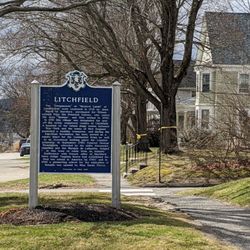
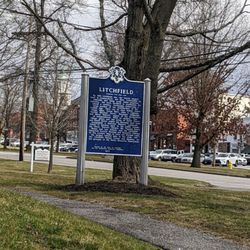
Located on the front lawn of Litchfield Town Hall, this is a two-sided marker from the CT Historical Commission in the familiar white lettering on a blue background. It dates to 1977 and is in very good condition.
The full inscription reads:
Litchfield
The "Greenwoods" or "Western Lands" of Connecticut were explored in 1715 by John Marsh of Hartford, purchased for fifteen pounds from the Potatuck Indians, who called the area "Bantam", and first settled in 1720. In 1751 this village was designated the seat of the newly organized county of Litchfield. A location on the inland stage routes between New York and the towns of New England promoted a healthy commerce, and during the American Revolution the town served as a supply depot for the Continental Army as well as an occasional holding place for Loyalist prisoners. In September 1780 General George Washington, attended by his aides Alexander Hamilton and the Marquis de Lafayette, lodged in this town en route from an historic conference with French allies at Hartford. Here Judge Tapping Reeve had established the first law school in America by 1784, and in 1792 a pioneering school for the education of females was opened by Miss Sarah Pierce.
(reverse)
By 1810 Litchfield was the fourth largest town in Connecticut, but then, overlooked by railroads and large scale water-powered industry, the town declined in population for almost a century, fortunately preserving a large portion of the architecture of her golden age. Here can be seen the houses where Ethan Allen, Aaron Burr, John C. Calhoun, Harriet Beecher Stowe, Benjamin Tallmadge, and Oliver Wolcott, signer of the Declaration of Independence, lived or studied. The village green and the areas of North Street and South Street within the Borough have been designated a National Historic Landmark. Points of interest open to the public include the Oliver Wolcott Library, the Tapping Reeve House and Law School, and the Litchfield Historical Society Museum and Research Library. At the western edge of town are Bantam Lake, the largest natural lake in the state, and the Litchfield nature center and Museum, on the grounds of the White memorial Foundation.
Erected by the Town of Litchfield
and the Connecticut Historical Commission
1977