The church of St Michel is one of Limoges' most interesting historical sights, located in the old…read morepart of the town, close to the site of the old castle (near Place Motte).
The church was built largely in the 14th and 15th centuries in the Late Gothic style, and contains the relics of St Martial, who brought Christianity to the Limousin area in the 3rd century, and those of St Loup.
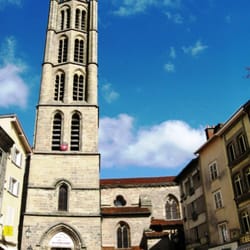
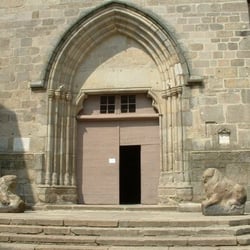
From the outside, much of the church is obscured by adjacent buildings, and the best vantage point is Place St Michel, from where the tower and steeple - surmounted by a golden ball - can best be appreciated. The tower was begun in 1383 and is just under 200ft high. The portal onto the square is flanked by two stone lions, from which the church derives its informal name of St Michel des Lions.
Inside, the space is a good example of a hall church, with a nave flanked by aisles of the same height, with chapels opening from each bay of the aisles. The slender, elegant clustered columns of the arcade lean at some alarming angles, but recent restoration work has provided additional (hidden) support to the vaults.
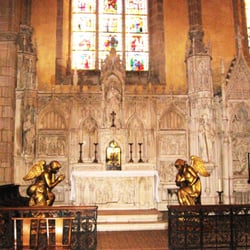
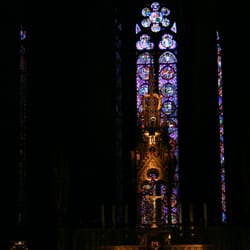
The chancel space is simply the end of the nave and aisles, and has an impressive 19th century carved reredos, the central part of which (behind the altar) holds the brass casket (1809) containing St Martial's relics. These were brought here after the destruction of the nearby Abbey of St Martial in 1790.
There are altars either side which, while technically separate chapels, actually form one continuous piece of sculpture.
Of greatest interest are the two east windows to the north and south of the central window, which both contain 15th century stained glass: that above the altar of St Loup depicts the Virgin and child, surrounded by medallions of the life of the Virgin. That above the altar of St Valerie depicts St John the Baptist, again surrounded by medallions depciting his life.
The rest of the church is also filled with stained glass, mostly from the 19th century and of varying quality, although there is no denying the dramatic overall effect. Other furnishings include the familiar 18th and 19th century baroque altarpieces in the chapels, some 16th and 17th century statuary and 19th and 20th century enamels.