During our recent visit to Salzburg, we HAD to tour a salt mine. Salzburg means "City of salt" and…read morethere are several mines in the vicinity. We settled on the Hallein Salt Mine, one of three mines operated by Salzwelten. It was the closest to Salzburg and could be easily reached by public transportation.
I'd visited the Wieliczka Salt Mine outside Kraków, Poland and found it fascinating so we wanted our family to have a similar experience.
For this tour, guests are required to don miners' attire, possibly to protect their own clothes but just as possibly to facilitate an easy glide down two miners' slides that we'd encounter during the tour. Once we'd pulled the white uniforms over our street clothes, we were off to the mine.
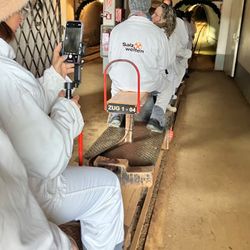
Our guide, Florian, was an excellent host. He told interesting stories and was quite approachable, but still strict about keeping our hands and feet in the car at all times - important because we'd soon be hurtling through very small tunnels cut into the rock and he didn't want anyone losing a cell phone - or worse.
After a short movie about the history of salt and this particular salt mine, we were taken to the mine train. Straddling the large beam used for seating, we were soon descending into the mine. Markers on the wall and ceiling showed us how deep below the surface we'd descended.
Visitors walk through even smaller tunnels after the train ride is concluded. Videos that were projected onto the rock walls of the mine at various points provided more background on this 2,600-year-old facility, and explained the various processes for extracting salt from the rock.
We were invited to taste the brine that resulted from one of the extraction techniques, the vacuum evaporation method. In this method, water is pumped down one well, the salt below is dissolved, and the resulting brine is forced to the surface through another well. The resulting brine, we were told, was about three times saltier than sea water. That brine would then be pumped into underground lakes where it would evaporate, leaving salt crystals behind.
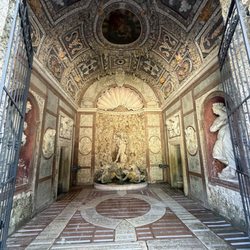
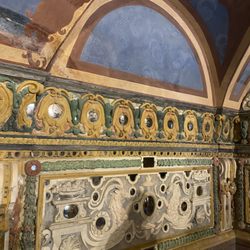
Along the way, we saw a shrine that the miners had erected in the underground tunnels, as well as several drawings and carvings on the walls.
Shortly into the tour, we came upon our first miners' slide. Florian gave a short briefing, stressing the importance of keeping our feet off the ground and off the rails until we'd reached the bottom, and then we were off.
As the tour continued, we walked through the narrow tunnels and uneven floors of the mine and remarked how it would have been helpful to bring a flashlight along, as the lighting was not especially great.
A second slide took us close to an underground salt lake, which was one of the evaporation ponds. Climbing onto a small barge, we were taken about 80 meters to the other shore.
Even though we were underground, international boundaries were still observed. At one point, the tour passed from Austria into neighboring Germany, and the crossing was marked by a sign similar to one we would see when we crossed back into Austria.
Near the end of the tour, we were shown a tree branch encrusted with salt crystals. Toward the end of the winter season, the miners would through leafless boughs into one of the abandoned pools. The twigs become encrusted with salt crystals and are quite dazzling, especially when the sun is shining. Called Salzburg Boughs, these became gifts salt miners would give to visitors to the mine.
Despite both being "salt mines," there are some significant differences between the Hallein mine and the Wieliczka mine.
The salt in the Hallein mine is embedded in the rocky soil and must be extracted through a variety of techniques while the Wieliczka miners primarily dealt with "salt domes" of more or less solid rock salt. As a result, Polish miners carved out a number of underground chapels, the largest of which is often rented out as an event venue today. They also replicated famous works of art by carving into the rock salt walls, including da Vinci's Last Supper.
Both mine tours offer fascinating insights into the importance of salt, both centuries ago when it was used as currency and was vital for food preservation, and its much more humble place in today's society.
Either tour is well worth the time; taking both tours will provide an excellent opportunity to "compare and contrast."