Cancel

    Open app

    Search

    Kirby Hall Photos

    Recommended Reviews - Kirby Hall

    Your trust is our priority, so businesses can't pay to alter or remove their reviews. Learn more about reviews.
    Yelp app icon
    Browse more easily on the app
    Review Feed Illustration

    18 years ago

    Helpful 0
    Thanks 0
    Love this 0
    Oh no 0

    18 years ago

    Helpful 0
    Thanks 0
    Love this 0
    Oh no 0

    Verify this business for free

    Get access to customer & competitor insights.

    Verify this business

    Rockingham Castle

    Rockingham Castle

    4.5(2 reviews)
    3.7 mi

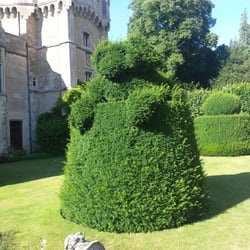
    Beautiful, romantic castle set on top of a hill looking over the forest. This is a day out for all…read morethe family. Stuffed full of early medieval history with very helpful guides to talk you around the place. The gardens are lovely and your kids with think the elephant hedge is fantastic. Lots of events throughout the year. Also events and jousting company in the grounds.

    Recognised by William the Conqueror as a strategically important site, Rockingham was established…read moreas an administrative base of the Normans by the end of the 11th century. But William was only continuing the trend set much earlier by pre-historic settlers. The natural defences encompassing this elevated site made it an ideal location for commanding the valley below, and since the Iron Age a hill fort of some description appears to have been positioned here. The castle remained a popular venue with successive kings, notably King John in the early years of the 13th century who not only enjoyed numerous hunting trips but also conducted much State business whilst staying at Rockingham Castle. Towards the end of the same century, Edward I demonstrated a keen interest in retaining this castle as a major royal residence by instigating a major programme of works to repair and refurbish the building. By the 15th century, however, Government operations were being handled almost entirely in London, and Rockingham Castle had ceased to become such an important venue. Consequently, Henry V was the last king to stay at Rockingham in 1422, and it was subsequently granted to Henry VI's queen and Edward IV's queen. Despite some general repairs being carried out during the succeeding years, the castle was found to be near derelict by the mid-16th century. It was at this time that Edward Watson was able to take a lease on the Rockingham estate, and for thirty years he worked on transforming the old medieval castle into a comfortable Tudor home. In 1619 Crown ownership of Rockingham Castle ended when King James I sold to Watson's grandson. Generations of the same family have occupied the castle now for some 400 years, each leaving their own mark on this magnificent house. Today the castle represents a golden-coloured architectural delight spanning some seven centuries of building.

    Burghley House - Burghley House

    Burghley House

    4.4(13 reviews)
    11.2 mi

    Burghley House is one of the grandest Elizabethan stately homes in the UK, and is surrounded by…read moregardens and extensive parkland. It has been used in over a dozen films and TV productions, including "Pride & Prejudice", "The Da Vinci Code", "Elizabeth: The Golden Age"; and "The Crown". To understand the significance of the house, a little history is helpful; it was built by Sir WIlliam Cecil (1520-1598), later Lord Burghley. He was one of the pre-eminent advisors of the Tudor period, and the closest advisor to Elizabeth I for most of her reign, acting variously as Secretary of State, Lord High Treasurer and Lord Privy Seal. His impressive tomb is in St Martin's church, in nearby Stamford. The house was built to reflect his status, paid for by the wool wealth from the Burghley estates, and his substantial income from the state appointments. As such, it is sometimes referred to as a "Prodigy House", one built on a palatial scale by noble families and courtiers, and capable of housing visiting Tudor and Stuart monarchs and their extensive retinues. The house itself was built between 1555 and 1587, and the exterior is largely faithful to this period. The design reflects the transition from a mediaeval courtyard house, with the Elizabethan desire for symmetry, to the emerging classical tastes of the Renaissance. The profusion of obelisks, turrets, chimneys and pennants is, however, thoroughly Tudor in style, and gives the house its unmistakeable profile. The interiors were not completed at Burghley's death, and reflect the emerging Baroque tastes of the 17th and early 18th centuries. There are 35 major rooms, many incredibly opulent, including those painted trompe d'oeil walls and ceilings by Antonio Verrio in 1697-99. A number of the rooms include stained glass windows, dating from the 16th and 17th centuries. The house also contains an impressive collection of over 300 paintings acquired by the 5th and 8th Earls of Exeter, mostly from Italy, as well as an important collection of Japanese export porcelain from the 17th century, and 18th century English furniture. Tours include the impressive Tudor kitchens, although the route doesn't enter through the main courtyard entrance, so it can be a bit puzzling. Much of the house remains in private occupation, though there is a lot to see in what is open to the public. The audio tours are very helpful at putting the interiors and collections into context, in what otherwise can a feel a slightly overwhelming experience. The gardens include a formal "Garden of Surprises" with a number of water features, a sculpture park, and more extensive parkland, modelled in the 18th century by Capability Brown. You can buy tickets just for the gardens, or a combined ticket for both gardens and the house. I'd leave at least an hour for the house, though we took two hours to go around (it all depends on your appetite for art and architecture). There's a cafe-restaurant in the Orangerie, and a smaller "Garden Cafe". We ate in the latter: it is a little pricey, but I found the food to be a cut above your average sandwich, and they had locally made ice cream as an extra treat.
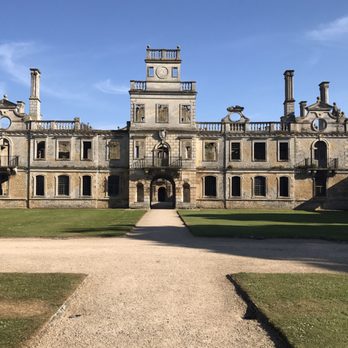
    It's okay. Very expensive for not great touring…read more Your ticket gets you into the gardens and house but only a very small portion of the home is available for viewing. In this section there are an astounding number of paintings but most are copies or unattributed. The furniture is beautiful. The gardens are pleasant but garden is a loose term. The best part was the mirror maze and the lake overlook but there were sparse plantings and almost no flowers. The orangery is one food option but the food is incredibly esoteric for a small, over priced cafe. The chicken tenders are a mediocre but safe option. Not impressed, wouldn't go back

    Photos
    Burghley House - Garden of Surprises, Burghley House

    Garden of Surprises, Burghley House

    Burghley House - Garden of Surprises, Burghley House

    Garden of Surprises, Burghley House

    Burghley House

    See all

    Peterborough Cathedral

    Peterborough Cathedral

    5.0(2 reviews)
    17.0 mi

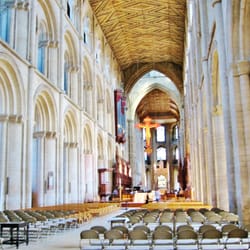
    Peterborough has one of England's best preserved Norman cathedrals, and has a colourful past not…read moreleast for being the burial place of Katherine of Aragon, Henry VIII's first wife, and having been the temporary burial place of Mary, Queen of Scots. It is known formally as the Cathedral Church of St Peter, St Paul and St Andrew. History The Anglo-Saxon King Peada founded the first monastery on the site in 655 although, like many, it was destroyed in a Viking raid in 870. Rebuilt as a Benedictine Abbey in 970, it survived a further attack around 1069, this time from Hereward the Wake, only to be destroyed by fire in 1116. The present building was built largely between 1118 and 1238, although the central tower was rebuilt in the Decorated Gothic style 1350-80. The East End was extended behind the apse to form a retrochoir in the Perpendicular Gothic style, between 1496 and 1508. Much of the cost of building the cathedral was funded by Pilgrims visiting some of the relics of St Thomas a Beckett, brought by Abbott Benedict a former Prior of Canterbury in 1177. Katherine of Aragon was buried here in 1536. After the dissolution of the monasteries, it became the Cathedral of the new Diocese of Peterborough in 1541. It was the also burial place of Mary, Queen of Scots, from her execution in 1587 until her reburial in Westminster Abbey in 1612. The cathedral was severely damaged during the Civil War by Cromwell's troops in 1643, but restored by J L Pearson in 1882-6. The Church The most notable external feature is the unique great west portico, consisting of three huge arches in the Early English Gothic style, flanked by square buttresses decorated with Gothic blind arcading and topped with tall pinnacles. The narrower centre arch had a smaller porch inserted into it in the late 14th century. Inside, the long nave of 10 bays is one of the best preserved Norman (Romanesque) examples of architecture in the country. Of particular interest is the wooden ceiling, a very rare survival, built in 1230-50 and decorated with lozenge-shaped panels containing the figures of kings, queens, saints and monsters. The crossing and choir are yet more Norman work, and contrast sharply with the Perpendicular retrochoir, which is notable for its profusion of fan vaulting. Most of the nave and choir windows were renewed in the 14th and 15th centuries, but only two windows above the High Altar retain fragments of mediaeval glass. Cromwell's troops destroyed many of the original fittings and furnishings, although the monument to Abbot Hedda (c. 800), caved with images of Jesus and Mary and ten disciples survives in the East End. Also extant are a number of marble effigies of Abbots dating between 1195 and 1225, and a fine carved 13th century font in the nave. A marble slab on the north choir aisle denotes the resting place of Katherine of Aragon (1485-1536) and in the opposite aisle the location of the former tomb of Mary, Queen of Scots is marked. An interesting picture hanging at the west end of the nave depicts Robert Scarlett (1496-1594), a gravedigger who buried both Katherine and Mary, and who lived to the age of 98. Today, the cathedral provides regular daily services and has a renowned choir, which sings a daily Evensong as well as during the Sunday services. It is open every day for visitors, except Boxing Day.

    Beautiful cathedral, worth the look, and it is free! Beautiful ceiling that I wasn't able to…read morecapture in photo. The fan traceries, blue of the length of the ceiling endif in the mural is stunning. Their website doesn't capture the beauty of the ceiling either.

    Photos
    Peterborough Cathedral
    Peterborough Cathedral
    Peterborough Cathedral

    See all

    Kirby Hall - landmarks - Updated May 2026

    Loading...
    Loading...
    Loading...