Cancel

    Open app

    Search

    Holy Trinity Church

    3.0 (1 review)

    Holy Trinity Church Photos

    Recommended Reviews - Holy Trinity Church

    Your trust is our priority, so businesses can't pay to alter or remove their reviews. Learn more about reviews.
    Yelp app icon
    Browse more easily on the app
    Review Feed Illustration
    Photo of Lee M.
    1
    78
    538

    3 years ago

    Helpful 0
    Thanks 0
    Love this 0
    Oh no 0

    The Church of the Immaculate Conception - Chapel with the "Homeless Christ" sculpture

    The Church of the Immaculate Conception

    5.0(6 reviews)
    1.2 miMayfair

    Tucked away on Farm Street, surrounded by residential mews and mansion blocks, the Jesuit Church of…read morethe Immaculate Conception could almost define the phrase 'hidden gem'. It is worth making a special effort to visit. The church itself was built in 1844-49 as a base for the Jesuit order in London, following the Catholic emancipation of 1829. The architect behind this jewel was Joseph John Scoles (1798-1863). He designed a number of Roman Catholic churches and, on the basis of the Immaculate Conception alone, deserves to be better known. For its early date, it is a remarkably confident, and accomplished, example of Gothic Revival. The facade is a fair introduction to the church, the (liturgical) west door surmounted by a striking Decorated Gothic west window, filled with delicate tracery in a bold rose design. But the interior steps up a gear: eight bays of clustered marble-clad columns, tall clerestory windows flooding the interior with light, all drawing the eye to the chancel and the high altar. The nave and chancel ceilings are stencilled and painted, the aisles vaulted. Every surface is covered with marble or decoration, the aisle chapels filled with sculpture and intricate blind arcading. Most notable is the chancel reredos, designed by Pugin, the stone brilliantly gilded, but there are some interesting side chapels too, one of which has a sculpture of "The Homeless Christ", showing Him wrapped up on a life-sized park bench. It became a parish church in 1966 and also has a significant ministry of outreach to refugees, young adults, LGTB+ Catholics, Japanese and Filipino congregations, and those considering returning to the faith. It also has a notable reputation for music. The church is open every day, with daily masses and confession.

    Looking for something beautiful and quiet, off-the-beaten track in London? This is one of them. The…read moreChurch is absolutely breath taking - both the exterior and interior. The surrounding park (Mount Street Gardens) are also well kept and very beautiful. Try and stop by to explore both the Church and the gardens if you're in the Mayfair area.

    Photos
    The Church of the Immaculate Conception
    The Church of the Immaculate Conception
    The Church of the Immaculate Conception

    See all

    Westminster Cathedral

    Westminster Cathedral

    4.3(28 reviews)
    0.8 miWestminster

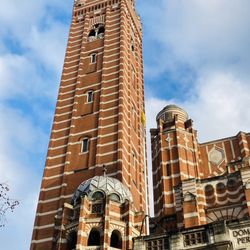
    Westminster Cathedral, not to be confused with Westminster Abbey is a beautiful Cathedral and the…read moremother Church of the Catholic Church in England and Wales. As in the name, it is located in the City of Westminster in the British capital, London. It can be seen from the "Victoria" end of Victoria Street, fairly close to Victoria Station as well as places to shop, eat and bank on the street and in Cardinal Place. It should of course not be confused with the nearby and similarly named Abbey. 284 feet high including the cross, it is pretty tall and magnificent in structure, although it was partly covered for refurbishment on the date of my recent visit, which was a shame. Inside the church, it was huge, it was beautiful and incredible and it definitely was an amazing sight, one of the things I hated about the Notre Dame was how they seemed more interested in making a profit, charging people to admire the beauty rather than having respect for what it is, a church, this is where Westminster Cathedral differs for the better, after admiring the church for a moment or two, I was approached by a friendly gentleman, I presume to be the priest telling me about their upcoming services for Lent and Easter, with my visit of course coming during April 2019. Since being built in the late 1800s and early 1900s, it is a Grade I listed building also. There was a small seating area outside to admire the structure of the building where you can take photos outside, albeit sadly mobile phones and photography are banned inside and there are people who make sure you don't do it (a real shame, I wanted to take photos for myself and for you guys on Yelp!) 4*

    I want to extend my gratitude to everyone at Westminster Cathedral through whom it turned out to be…read morea landmark cloaked in epiphany for me: that is, not all churches are equal (by grace). Marvellousely, there cohabit prayer and taxation in equal measure - underprivileged communities who serve as the mob (MAFIA) run by the priests ( and who would gladly suck up to anyone) will shake you well a couple of times before you leave. I have noticed people running for the restrooms when they see them approaching with their clanking donation vessels. You would think that the priestly grandeur of the ministers offsets this minor blooper. Well, they definitely add up to the impression upon a visitor - for myself I can say I have never been objectified so good since the feminism thing arose. On the one hand, there is this competition between the dean and one of the priests about who is going to get the most girls (their attention supposedly). The said priest, who was a nurse in another life, dully upholding his part in the rivalry, would seek me out in the crowd and keep an eye contact until my eyes fall out; on a lucky days he would feed me the communion with such a longing that would make my shoes give in. On the other hand stands alone this elderly priest, who would simply look at my legs until he goes weak and leave no doubt that we had indelible moments, which in turn made me glad to meet his alb and cincture, too. However, the intrigues were the best part there - the assiduous handmaids collecting the money would report you to the priests if you haven't donated and you would find yourself a part of the mass' homily when the priests usually "throw stones". As a finance graduate degree holder, I would suggest that the church manage her money more effectively, instead. I can't decide which of these examples appeal to me but surely I made my mind that not all churches are equal. -- K.D.--

    Photos
    Westminster Cathedral
    Westminster Cathedral
    Westminster Cathedral

    See all

    St Paul's Church Knightsbridge

    St Paul's Church Knightsbridge

    4.8(4 reviews)
    0.6 miBelgravia

    A true gem. I was surprised by how much I enjoyed visiting this Cathedral. 40+ years ago I visited…read moreWinchester Cathedral so really wanted to to see St. Paul's. Unlike Winchester We found it uncrowded and easy to meander around. My pictures certainly do not do it justice. It is of course breathtakingly beautiful but beyond this it is calm, moving, relaxed. One place in particular was the area behind the alter where there is a most moving tribute to the Americans that fought alongside them during World War II. I just choked up. Below in the Crypt you cannot avoid walking across the many many folks buried there. And I wonder, how many more years it will be before this area is closed off to the public. The floor stone inscriptions are getting incredibly worn. Do not miss the Crypt.

    St Paul's, Knightsbridge, is one of those hidden gems: so close to the busy thoroughfares of…read moreKnightsbridge and Belgrave Square, so close to the touristy hot-spot of Hyde Park Corner, and yet unknown to most of those who pass by. Perhaps that is to the benefit of those who do know about it: a church that is open on most days, its neo-Gothic splendour - and splendour is the right word here - providing an oasis of calmness and tranquility in the midst of rushing madness. The need for church here was becoming clearly evident in the early 19th century as the development of Belgravia and Knightsbridge started in earnest. The church was built mostly by private subscription: Thomas Cundy the younger was appointed architect, and the work was undertaken 1840-1843. History The church was perhaps the first in London to champion the principles of the Oxford Movement, which emphasised a return to the rituals and traditions of the Catholic church, and debates and controversy arising from this dominated the first 50 years of its life. The Chancel was lengthened in 1871-2 and again in 1892 by the well-known church architect G F Bodley, with the addition of a side chapel by the equally well-known A Blomfield in 1889. Architecture The church itself is built in the Perpendicular Gothic style, of yellow brick with Bath stone dressings. It has a prominent (though to me, oddly under-sized) western clock tower. The exterior is handsome enough, but does not prepare you at all for the interior: the first impression is one of a vast space - the nave is both wide and high - and of the unusual retention of large galleries, supported on cast-iron columns on the north, south and west sides. The Chancel is separated by a full and elaborate rood screen - the work of Bodley, as is the design of much of the rest of the lavish decorative scheme, including the East Window. The theme of elaborate decoration continues unabated throughout the church: the walls have tiled panels depicting scenes from the life of Christ (by Daniel Bell) interspersed with painted stations of the Cross (by Gerald Moira), and statuary and paintings abound. My favourite is actually the ceiling, painted but given structure by the impressive wooden ceiling trusses. Unsurprisingly, it is a Grade-II* Listed Building. The church is today centre of a very busy parish life. In its past, it has been associated with the great and the good, although these days it emphasises its inclusiveness. It has a rich tradition of music, and is also a venue for regular concerts.

    Photos
    St Paul's Church Knightsbridge
    St Paul's Church Knightsbridge - #LiveLifeLikeLDN

    #LiveLifeLikeLDN

    St Paul's Church Knightsbridge

    See all

    St. Peter's Church Belgravia

    St. Peter's Church Belgravia

    4.0(3 reviews)
    0.5 miBelgravia

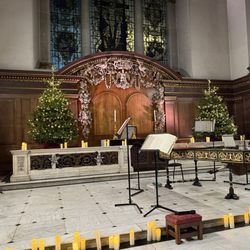
    I did not attend any services here. But I attended and…read moreparticipated in several days of large-scale choral rehearsal prior to a festival performance. The space was lovely, somehow both clean and ornate. The organ is a grand surprise to turn around and see. The sound in the space is gorgeous. And it was a comfortable enough place to have a 3+ hour rehearsal. Bathrooms were clean and the group, I think, felt welcome in the space.

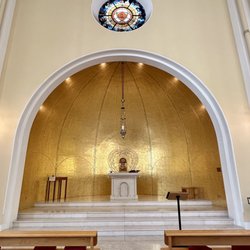
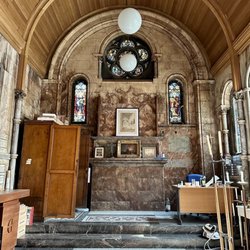
    Eaton Square is not one my favourite squares in London. Grand in scale, bisected by the busy and…read morewindswept King's Road, with its gardens denied to the public by railings, it does not feel like a welcoming, public space. Fortunately, the Victoria station end is enlivened by the handsome proportions of St Peter's Church, with its fine Ionic portico and tower. Built between 1824 and 1827 during the first phase of development, it was designed by the architect Henry Hakewill. The interior was, as was common at the time, a severe preaching box, with the organ and choir at the West end. In 1875, it was enlarged by Sir Arthur Blomfield, and reordered to provide a chancel at the East End, in the Romanesque style, although externally the changes remained faithful to the original classical style. However, in 1987 an arsonist set fire to the East End, and within hours the entire church was engulfed. The following day, although the fire was out, the church was roofless, with most of its furnishings destroyed. An extensive programme of rebuilding was set in hand, with a new and simpler interior design, also incorporating offices and flats within the space. The interior therefore comes as something of a shock after passing under the grand portico, as it is clean, bright and modern. The choir and organ are located at the West End again, as in the 1827 plan, although the fittings are thoroughly modern. The church is accessible, with disabled toilets available. Whether this works for you is a matter of taste, although I find it a little too bright and clinical. That said, behind the altar is an attractive apse, decorated entirely with gold mosaic. Walk around the side of the apse, and you find part of the 1873 sanctuary which survived the fire, and a side chapel now used as the Vestry office, complete with stained glass. But whatever the merits of the internal architecture, there's no doubt that the church is the centre of a lively and active parish life, with worship in an inclusive, modern catholic style, an excellent professional mixed choir (best experienced at the 11.15 Sung Eucharist on Sundays), regular concerts and talks.

    Photos
    St. Peter's Church Belgravia
    St. Peter's Church Belgravia
    St. Peter's Church Belgravia

    See all

    Holy Trinity Church - religiousorgs - Updated May 2026

    Loading...
    Loading...
    Loading...