Cancel

Open app

Search

High Street Photos

High Street Reviews in Other Languages

Verify this business for free

Get access to customer & competitor insights.

Verify this business

Medieval Merchants House - Medieval Merchants House - exterior

Medieval Merchants House

4.0(1 review)
1.2 km

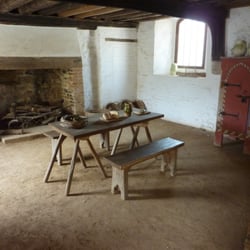
The Medieval Merchants House is an English Heritage site in the historic part of Southampton. It is…read morea small building ( http://www.yelp.co.uk/biz_photos/Q6XqH1E05lB2nIlwJStggw?select=HacP6tvKNjQY2oWBVKmJ9Q ), with a dirt floor on the ground level, and some upstairs rooms and a cellar. Considering the overall size of the property, the entrance fee seems a bit steep. The audio guide is fairly lengthy, describing the typical life of the inhabitants: a wealthy Southampton wine merchant and his family, and guests. Actually, the audio guide is really lengthy, which is good for the history fans, but not great when you've got small kids in your group. The site staff did open up the large wine cellar for us, under the building, and let us inside it. Overall, while the history is great (you can get a good sense of what Southampton was like as a port in the Middle Ages), the site is pretty small - like 5 rooms total, plus the cellar. For history fans, it's cool, but for random entertainment, its value per admission isn't great. OPENING TIMES: we must have lucky in our trip, since according to the English Heritage website, the Medieval Merchant's House is only open on Sundays (noon to five pm). Accessibility note: since it is an old building with a dirt floor, strollers aren't admitted, but can be left with the museum staff in the entry room/gift shop. Steep stairs for the upstairs and for the wine cellar.

Photos
Medieval Merchants House - Main Hall interior

Main Hall interior

Medieval Merchants House - Kitchen

Kitchen

Medieval Merchants House

See all

Titchfield Abbey

Titchfield Abbey

4.0(3 reviews)
13.6 km

On our Road Trip through England, Wales and Scotland we focused on Castles, Abbeys and walks…read more The Titchfield Abbey we've visited on our first full day here in England. It was a hot summer day. A monday. And only really a handful people on site. Which is surprising, because these are beautiful remains of a former abbey and mansion. It's almost still fully complete even. There's no entrance fee. And even parking is free if you're a member of the EH. If not it's 2£ only. The building is very impressive. Built in the 13th Century it was first in the hand of monks. Then it changed hands under Henry VIII. And was turned into a Tudor mansion. It's quite a sight to behold. And you can walk around the whole site. But as usual: Be respectful, don't climb around and pick up your litter and after your dog (which are allowed here on the site). A very good start for this year's Road Trip. A great place to visit. And there are even one or two lunch options around, if you feel hungry after your visit.

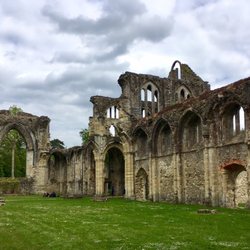
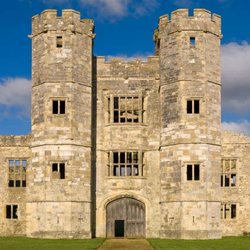
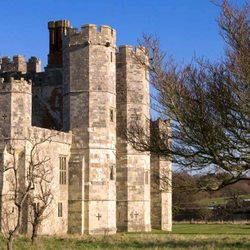
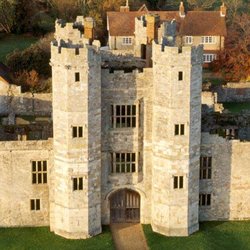
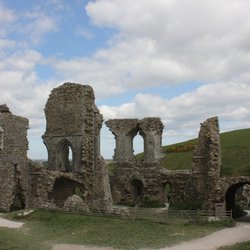
Titchfield Abbey is a ruined former country home, which was itself adapted from an Abbey during the…read moreDissolution. The Abbey was founded in 1222 by the Premonstratensian Order of canons. It was founded as a daughter house of Halesowen Abbey, and endowed both by its founder Bishop Peter of Winchester and Henry III. Never especially wealthy, the Abbey was nevertheless noted for its scholarship and held a substantial library. The Abbey buildings followed a standard plan, albeit on a relatively modest scale. The Abbey seems to have had a quiet and ordered existence, although it's location near the south coast on one of the main routes to France meant it hosted both Richard II and Henry V, and was the location of Henry VI to Margaret of Anjou in 1445. The Abbey was dissolved in 1537, at the behest of Thomas Wriothesely, Chancellor to Henry VIII. Unlike many dissolutions, the Abbott John Salisbury secured a peaceful handover, with pensions provided for the canons and the position of Dean of Norwich for himself in 1539. Wriothesely adapted the buildings to form a n impressive country home for himself, called Place House. The Abbey church itself was converted to a grand gatehouse and accommodation wing, with a long gallery and hall formed around the former cloister. This involved taking down the church tower and chancel. The house hosted Elizabeth I, Edward VI, Charles I and Charles II. It continued in use as a home until the 1780s, when the decision was taken to abandon and deliberately demolish much of the complex to form a romantic ruin. Today it is in the care of English Heritage. The impressive turreted gatehouse forms the larger part of what is visible today, the bare structure enabling much of the former church to be traced. There are also remains of the cloister walls, with the foundations of the demolished buildings traced out on the ground. The site is also known for its collection of decorative mediaeval floor tiles. The adjacent fish ponds have survived but are no longer part of the site. Practicalities: the gravel drive is quite narrow and leads to a gravel car park. Although there is level access the rough surfaces make for challenging wheelchair access. There are no toilets on site.

Photos
Titchfield Abbey
Titchfield Abbey
Titchfield Abbey

See all

Bishop’s Waltham Palace - Information board

Bishop’s Waltham Palace

4.0(1 review)
14.1 km

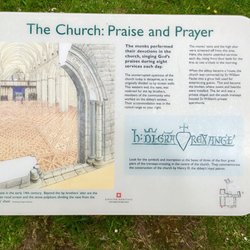
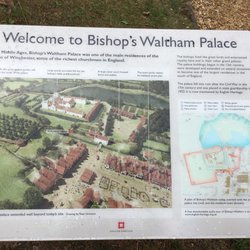
This site comprises the remains of a once-splendid mediaeval palace of the Bishops of Winchester…read more It has free entry and is a great place for a picnic. The Palace was begun by Henry of Blois in 1135. Further expansion was undertaken in 1160-80; again by William of Wykeham (bishop from 1367 and founder of Winchester College and New College, Oxford), Bishop Henry Beaufort (1405-1447) and finally by Bishop Langton (1493-1501). Occupied until the Civil War in the mid 17th Century, thereafter it fell into disrepair, and much of the stonework was removed for use in other buildings. However, enough remains to appreciate the grand scale of the palace. During its heyday, it was much visited by royalty, including Henry II to Henry VI, Richard the Lionheart, Edward IV and Elizabeth I. Henry VIII entertained the Holy Roman Emperor, Charles V, here in 1522; and Mary I stayed here prior to her wedding to the future Philip II in 1554. What remains now is an impressive and entirely moated site (still partly watered), with, on the west side, the substantial remains of Wykeham's Great Hall, the kitchen and service rooms. Beyond this is the south-west tower, still standing 20m high, and picturesquely covered with foliage. Only part of the Bishops' apartments remain. The outline of the cloister is clearly visible and the undercroft of the chapel is now occupied by a picnic table! The east range, built in the 15th Century with alterations in the 16th, is also substantially intact, and once housed a bakehouse and brewery. To the east of the site, some of the large fishponds survive, used to supply the palace with fresh fish. A red-brick building with mediaeval timber framing next to the east range now houses the small town museum, open summer weekends 2pm-4pm. The site has a small car park but is only a few minutes' walk from the centre of the town. There are information boards at key points around the site.

Photos
Bishop’s Waltham Palace - Information board

Information board

Bishop’s Waltham Palace - Information board

Information board

Bishop’s Waltham Palace - Bishop's Waltham Palace - east range

See all

Bishop's Waltham Palace - east range

High Street - landmarks - Updated May 2026

Loading...
Loading...
Loading...