We visited the National Memorial for Peace and Justice (NMPJ) on Jan 8, 2026 as part of Road…read moreScholar's "The Civil Rights Movement - Atlanta, Montgomery, Selma, Birmingham" program. It is one of the three Equal Justice Initiative (EJI) Legacy sites in Montgomery, AL, and the only one where photography is allowed. Like with the other two sites, security checkpoint is present and I surrendered my foldable (smartphone) tripod.
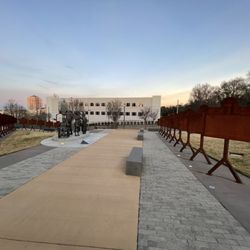
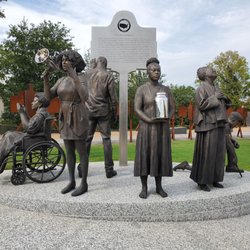
While the Freedom Monument Sculpture Park has a collection of artwork in a park setting, the entire area of the NMPJ can be seen as a single artwork of many sections, like the long wall mural in Dexter Ave Baptist Church (also in Montgomery; within walking distance from the Legacy Museum). The first section of NMPJ is a large grassy area bordered by walkways, wall-mounted written content on the subject of "from slavery to lynching". and the Nkyinkyim Installation sculpture. I don't know if picnics or napping on the grassy area is allowed. I didn't ask. Walking from this area to the next section took time.
The next section, being the memorial temple, is the highlight of NMPJ. An open structure that houses numerous tall tablets resembling coffins. Each tablet bears the names of county and state, followed by the names of lynching victims and their respective dates of death. Initially, the tablets look like they are resting on the floor. At the center of the temple is a grassy square accessible from multiple points. Standing at the center of the square, the visitor can see the sheer masses of deaths memorialized within the temple. (Photos and footages are found on my YouTube channel @1Somber. Look for video title "Day 5: National Memorial for Peace and Justice, Freedom Monument Sculpture Park" in playlist "2026-1: The Civil Rights Movement - Atlanta, Montgomery, Selma, Birmingham".)
At one end of the structure, the path turns right to a corridor that slopes down. I then realized that the tablets are hanging from the ceiling. When the corridor reaches the bottom level, the tables are hanging over my head. Mounted on opposite walls are panels, each mentions the known "justification" for the victim's death. Why only the bottommost area of the panel is used is a mystery. I hope in time more names will be added to these panels. The final wall has an inscription draped by a waterfall states that the "victims of racial terror lynchings... whose deaths cannot be documented... whose names will never be known... are all honored here."
Leaving memorial temple, I came to Monument Park. In this area, the tablets take on the shape and size of coffins, and lay on the ground rows after rows on the left and the right of the walkway. Like the tablets at the memorial temple, each bears the names of county and state, followed by the names of lynching victims and their respective dates of death. After Monument Park comes the "Guided By Justice" sculpture, and then Community Park. Tablets shaped like signposts line up in a single file to one side, and act as shoulders for the visitor walkway. Each has written details of specific lynchings. I followed these "signposts" and arrived at the "Arise" sculpture. The path then leads back to starting point. Visitors can either go for another round or leave.
Our tour guide said that a visit at the NMPJ can be done in 45 minutes. I say, "Take all the time you want." The patrolling staff is sparse and there's no hurry. The $5 admission price covers all three EJI sites. Although I appreciated the NMPJ, particularly capturing a considerable amount of photos and footages, I do not give this place 5 stars because of the unnecessary security checkpoint to do the boat ride from Boat Launch at 101 Morris Street to Freedom Monument Sculpture Park, and vice versa. See attached image for further details.
At 12:56pm, after visiting the National Memorial for Peace and Justice (NMPJ), I showed up at Boat Launch. There was a security checkpoint. I was told to turn over my tripod before getting on the boat. The big, burly bespectacled guy in the suit claimed that tripods could be used to vandalize the sculptures, and I could take the boat back and to this pier to get it back. He gave no explanation as to how a tripod would be a hazardous or dangerous object on a boat ride itself. The Sculpture Park has its own security checkpoint where I would turn over the tripod, and I wasn't planning on coming back to this pier just to pick up my tripod. It would be a waste of time. So I waited for the shuttle to take me back to the Legacy Museum after stopping over at NMPJ.
When I finally arrived at Sculpture Park, 45 minutes of my time was wasted. This limited the time spent there. There was no necessity to have security checkpoint at Boat Launch when Sculpture Park has its own security checkpoint. Until EJI Legacy updates their policy to one that makes sense, this EJI site gets no more than three stars.