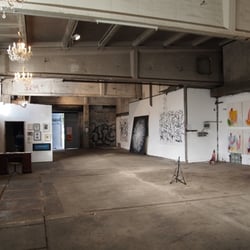
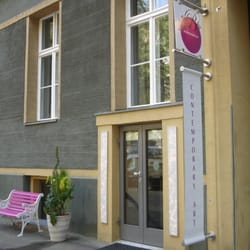
KW is Berlin's top space for exhibiting contemporary art. Since 1998 it has hosted the Berlin…read moreBiennial. This summer's edition is different from the past ones. In the downstairs gallery there is an encampment of the sort that Occupy movements have set up in cities. There are tents, brochures, graffiti, posters, and occasional assemblies. The galleries upstairs feature work that seems closer to agitprop than it does to art--a deliberate choice on the part of the curator, Artur Zmijewski, who writes in his introduction to the catalog that contemporary art doesn't interest him any more. A Powerpoint presentation by Antanas Mockus, formerly the mayor of Bogota, Colombia, discusses his campaigns against the drug business and traffic deaths that involved elements of performance art (respectively: when he got death threats from drug lords he started wearing a bulletproof vest with a heart-shaped hole cut over his heart, and he had mimes line up along sidewalks). In the presentation he says this is "sub-art = art without the pretenses of art."
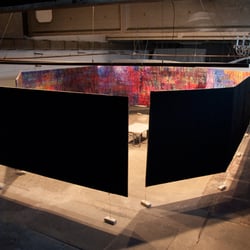
Everything at the Berlin Biennial could probably be described as sub-art. For example, one room has a lopsided circle of screens, each of which displays documentation of a protest that took place somewhere in the world in the last year. It looks like a complex video-art installation, but when I was inside it I felt like I was at a protest meeting, an assembly of assemblies where I couldn't possibly see and focus on the whole thing at once but I still got an impression of a worldwide movement that I could potentially belong to. Likewise, the Occupy encampment on the ground floor looks the sprawling, cluttered installations you see at a lot of biennials, combining a variety of images, texts, and objects. But the sharp cuts between old radical documents (a printout of the 1996 "Declaration of Independence of Cyberspace") and current, useful information (a flyer with instructions on how to get from Berlin to Occupy Frankfurt next week) make it feel like something else. Maybe, because of its position right at the entrance, it's supposed to be a proposition about how works of sub-art engage each other in dialogue.
To be honest, I have never liked "political art." When art has a direct message it becomes one-sided and shallow. But I didn't want to judge the Berlin Biennial by the criteria of art because it defines itself as non-art, as sub-art that is occupying a kunsthalle. Of course, there are individual works here with legible agendas. But it's like an Occupy meeting, where there are people handing out leaflets or starting discussions to promote their own pet causes, but they're still working under the umbrella slogan of "no demands," a rejection of the present system that refuses to participate in its politics. This Berlin Biennial presents an aesthetics of "no demands." Instead of issuing the sort of bland political statement that biennials usually give when they try to get political, it rejects familiar exhibition formats and the expectations people have for contemporary art. It's a biennial and an anti-biennial--a position that has the ambiguity and richness that makes for good art but also feels different and new. That's the impression I got, and it was exciting for me.
A lot of people I talked to about the Berlin Biennial hated it. They thought it was political art and it didn't have teeth, that in spite of its good intentions it was disconnected from life, that it cheapened the Occupy movement by turning it into an installation. By doing this project at KW with funds from the German government, these critics say, Zmijewski et al are capitulating to the system that the Occupy movement rejects. To me this sounded a bit like the people who call Occupy protesters hypocrites because they use laptops made by successful corporations. But that's ridiculous. You don't start a co-op that makes its own computers from scratch to organize a protest. You don't build an Institute for Sub-Art to have a biennial. You just use the means that are available to you and in using them you remake them.
I also heard rumors about corruption, mismanagement of funds, complaints that artists were not paid fairly. These are probably true. But in the end I can only evaluate an exhibition space based on my personal experience there, and my experience at KW was very positive.
If you are set in your ideas about what a biennial or other big group show should look like then maybe KW (especially with this Biennial!) is not for you. But if you are open to new ideas and like to be intellectually challenged I would highly recommend it!
TIP: You don't have to walk through the ticket office to get to the galleries and the attendants don't check tickets so it's really easy to see the show without paying. I did it twice.