Cancel

    Open app

    Search

    Frog Rock Photos

    Recommended Reviews - Frog Rock

    Your trust is our priority, so businesses can't pay to alter or remove their reviews. Learn more about reviews.
    Yelp app icon
    Browse more easily on the app
    Review Feed Illustration

    3 years ago

    Helpful 18
    Thanks 2
    Love this 17
    Oh no 0

    Verify this business for free

    Get access to customer & competitor insights.

    Verify this business

    Cornwall Historical Marker

    Cornwall Historical Marker

    4.0(2 reviews)
    4.3 mi

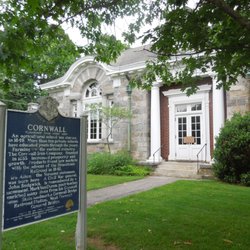
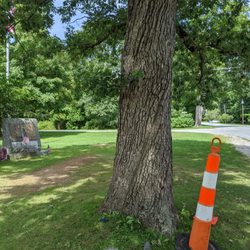
    So my dog and I decided to take a nice socially distanced walk in Cornwall, and see this lovely…read moresign while there. Right now, being between two blizzards, it's really hard to get to the back of the sign, but the front is readily accessible from the cleared sidewalk. Interestingly, the Town Hall still has Christmas decoration up in the windows. You can literally hear cows mooing in the distance, that's how peaceful and country this sign is.

    This is the 140th historical marker I photographed and wrote about. But it's the very first time…read morethat what I read and what I'm writing includes the word "Obookiah". That's a "who?" and not a "what?", because the O Man was a Hawaiian student at Cornwall's Foreign Mission School two hundred years ago. That's one of the historical nuggets you'll read about on this marker. It's a two-sided marker from the CT Historical Commission with the familiar white lettering on a blue background. Its located on the front lawn at Town Hall on Pine Street. The sign dates to 1975, and its condition shows some signs of wear and tear -staining, fading, and peeling. Obookiah would be sad to see that. The full inscription reads: This area was once part of the Western Lands ordered surveyed by the Legislature in 1731. Yale Lands were surveyed and three hundred acres were set aside for income for Yale College in 1732. At an auction in Fairfield in 1738 the town was sold in fifty shares, named Cornwall, and incorporated in 1740. After the church "gathered" in 1740 schools began to open. In time there were seventeen school districts. The Foreign Mission School in 1817 numbered among the students an Hawaiian, Obookiah, who links Cornwall eternally to Hawaii. An agricultural school was started in 1849. More than ten private schools have educated youth through the years. Farming was the earliest industry. The Cornwall Iron Company, founded in 1833, increased prosperity and growth. Products found new markets with the advent of the Housatonic Railroad in 1842. Ira Allen, the Vermont statesman, was born here. A Civil War general, John Sedgwick, is remembered by a monument. Mark Van Doren, poet-teacher, enriched many lives from his Cornwall home. State Landmarks: Cornwall Bridge Railroad Station, West Cornwall Covered Bridge. Erected by the Town of Cornwall The American Revolution Bicentennial Committee of Cornwall and the Connecticut Historical Commission 1975

    Photos
    Cornwall Historical Marker
    Cornwall Historical Marker
    Cornwall Historical Marker

    See all

    Kent Historical Marker

    Kent Historical Marker

    3.5(2 reviews)
    5.3 mi

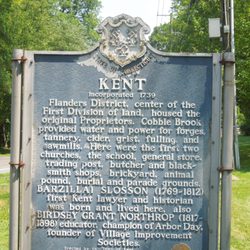
    It's nice this sign is on a quieter part of the road in front of the historical society, instead of…read morein front of another town hall. It is a little disappointing that the quiet road goes so fast. The sign is at a T intersection, and has a pull off just before the stop sign. There is no stop sign on Route 7, but cars move fast. Stop and observe this sign at your own caution! The actual sign needs a new coat of paint. It is still legible, but doesn't have as much information about Kent that I would have expected. The front and back say the same thing!

    Ever run into the first name Barzillai before? Neither did I, but I saw his name on the marker. He…read morewas a historian and Kent's first lawyer. This is a 2-sided marker from the CT Historical Commission in the familiar white lettering on a blue background. It has the same inscription on each side. You'll find it on a small strip of grass where Kent Cornwall Road hits Cobble Road. The marker was dedicated in 1975 and is in below average condition with evidence of fading and chipping at the top of both sides. The full inscription reads: Kent Incorporated 1739 Flanders District, center of the First Division of land, housed the original Proprietors. Cobble Brook provided water and power for forges, tannery, cider, grist, fulling, and sawmills. Here were the first two churches, the school, general store, trading post, butcher and blacksmith shops, brickyard, animal pound, burial and parade grounds. BARZILLAI SLOSSON (1769-1812) first Kent lawyer and historian was born and lived here, also BIRDSEY GRANT NORTHROP (1817-1898) educator, champion of Arbor Day, founder of Village Improvement Societies. Erected 1975 by Town of Kent, Kent Historical Society and Connecticut Historical Commission.

    Photos
    Kent Historical Marker
    Kent Historical Marker
    Kent Historical Marker

    See all

    Warren Historical Marker

    Warren Historical Marker

    4.0(1 review)
    4.4 mi

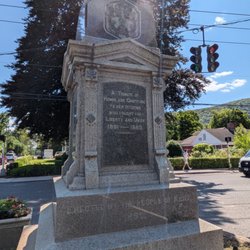
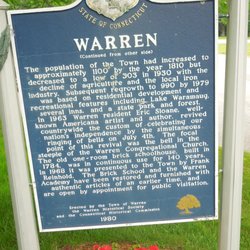
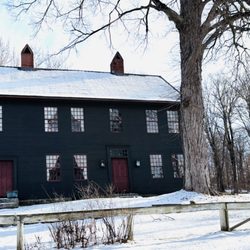
    The tiny town of Warren, CT sent 43 men to fight in the Revolutionary War. It was named after…read moreGeneral Warren, a hero of that war who was slain at the Battle of Bunker Hill. The Warren Historical Marker spotlights that connection to America's War for Independence and the value the town placed on education and the world of academia. It's a two-sided marker from the CT Historical Commission with the familiar white lettering on a blue background. You'll see it on a grassy stretch of land more or less across the street from Town Hall. The sign dates to 1980, and its condition shows some signs of wear and tear -staining, fading, and peeling, especially on the front side. Side two is in pretty good condition. The full inscription reads: This area was settled in 1737 as part of the Town of Kent. A separate ecclesiastical society called the Society of East Greenwich, established in 1750, led to the founding of a church in 1756 and a separate town in 1786. It was named in honor of General Joseph Warren, hero of the Revolutionary War, who was slain in the battle of Bunker Hill. In the first century and a half of its life, Warren not only sent forty-three of its men into that war but later, even though engaged mainly in farming, the Town became known as an educational center. Five private schools and academies produced fifteen ministers and educators. Among them were Charles G. Finney, revivalist and president of Oberlin College 1851-1866, and Julian M. Sturtevant, minister and president of Illinois College 1844-1876. During a half century commencing in 1772, more than 2837 Warren emigrants took part in settling new territories to the north and west. The population of the town had increased to approximately 1100 by the year 1810 but decreased to a low of 303 in 1930 with the decline of agriculture and the local iron industry. Subsequent regrowth to 990 by 1979 was based on residential development and recreational features including Lake Waramaug, several inns, and a state park and forest. In 1963 Warren resident Eric Sloane, well-known American artist and author, revived countrywide the custom of celebrating our nation's independence by the simultaneous ringing of bells on July 4th. The focal point of the revival was the bell in the steeple of the Warren Congregational Church. The old one-room brick schoolhouse, built in 1784, was in continuous use for 140 years. In 1968 it was presented to the Town by Frank Reinhold. The Brick School and the Warren Academy have been restored and furnished with authentic articles of an earlier time, and are open by appointment for public visitation. Erected by the Town of Warren the Warren Historical Society and the Connecticut Historical Commission 1980

    Photos
    Warren Historical Marker
    Warren Historical Marker
    Warren Historical Marker

    See all

    Frog Rock - landmarks - Updated May 2026

    Loading...
    Loading...
    Loading...