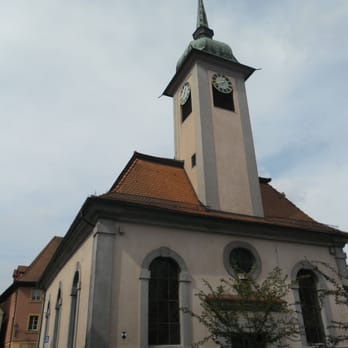
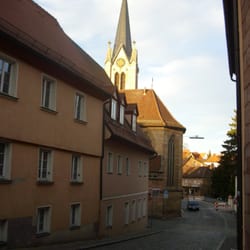
Evangelisch-Lutherische (Lutheran) Church in Schwabach. I believe it is officially called…read moreStadtkirche St. Johannis und St. Martin. It is truly a remarkable Gothic church, and it's worth your time when you are in Schwabach (not too far from Nürnberg).
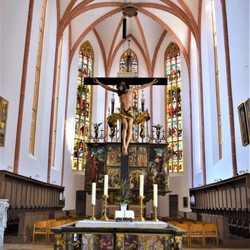
It is the town church of Schwabach and the main church of the Evangelical-Lutheran parish of Schwabach-St. Martin. Due to its central location directly at the town hall, it characterizes the cityscape of Schwabach. It is dedicated to Saint John the Baptist and Saint Martin of Tours, the patron saints of Franconia. As the most important sight, it houses the Schwabacher Altar--the high altar, the Coronation of Mary is at the central shrine, is one of the largest late Gothic winged-altars, more than fifteen meters high and more than six and a half meters wide. It comes from the workshop of Michael Wolgemut, famous Albrecht Dürer's teacher, and was completed in 1508. With its impressive carvings, the late-Gothic convertible altar, is a classic example of the use of gold leaf.
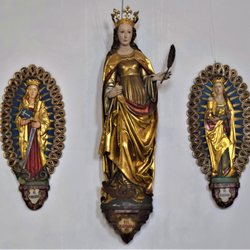
The church was rebuilt in the Gothic style from around 1410. The chancel and the associated roof structure date from this construction phase (dendrochronologically dated 1418/19). From 1469 to 1495 the nave was built as a three-nave relay hall. The church remained intact during the Reformation, the Thirty Years' War and the Second World War, which means that almost all of the art treasures have been preserved in their original condition. Paintings and gold leaf laid sculptures from the 15th/16th century are remarkable to see.
Evidence of the admission of Austrian religious refugees (exiles) in the 17th century can be found in front of the high altar (photo). A bronze epitaph indicates the grave of Agnes Dangrieß, who came from Eferding near Linz and fled with her family via Regensburg to Schwabach in 1625/26. The Dangrieß couple became committed members of the community and successful restaurateurs in their new home. During the Thirty Years' War, which reached Schwabach in the summer of 1632, and in which the town was captured by Wallenstein's troops, the town church served as a refuge for many citizens. In the epitaph aforementioned, an inscription indicates the death of Agnes Dangrieß only a few months after the end of the war. Another impressive tomb of an exultant is to the right behind the high altar. Catharina von Bernerdin, née von Handel, was one of a group of refugees who left Styria after the war and made their way to the "promised land", i.e. the Protestant German principalities and Imperial cities.
The church went through an extensive renovation from March 2010 to 2014 during which period the church was closed. The total cost of the renovation was expected to be over five million euros at the beginning of the project.