Hello yelp friend and readers. Thank you so much for visiting my page and checking out my reviews!…read moreIt means a great deal to me and I do my very best to introduce worthwhile places to visit with a dollop of historical details for knowledge.
FEBRUARY is traditionally honored as Black History Month and last year in 2021 I decided to do a month long series where every day of the month I posted a new review either highlighting a black-owned business or Black History landmarks. I've decided to extend that series to 2022, so please come on a journey with me for the next 28 days as I explore the food, history and significant offerings of a rich culture of people.
FIRST UP is Toni Morisson's BENCH BY THE ROAD #1
***
Born Chloe Ardelia Wofford, Toni was an American novelist who wrote the critically acclaimed Song of Solomon and won a Pulitzer Prize for the book Beloved in 1988 whom Oprah made into a movie 10 years later in 1998. She was most notably awarded the Nobel Prize in Literature in 1993. She met Harold Morrison (a Jamaican architect) while teaching at Howard University and married him in 1958.
The 'Bench By The Road' Project was launched on February 18, 2006, on the occasion of Toni's 75th Birthday to alleviate the absences of historical markers that help remember the lives of Africans who were enslaved. She said:
"There is no place you or I can go, to think about or not think about, to summon the presences of, or recollect the absences of slaves . . . There is no suitable memorial, or plaque, or wreath, or wall, or park, or skyscraper lobby. There's no 300-foot tower, there's no small bench by the road. There is not even a tree scored, an initial that I can visit or you can visit in Charleston or Savannah or New York or Providence or better still on the banks of the Mississippi. And because such a place doesn't exist . . ."
***
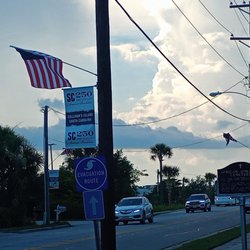
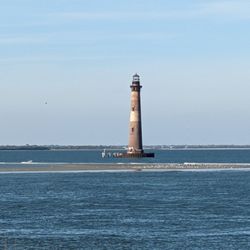
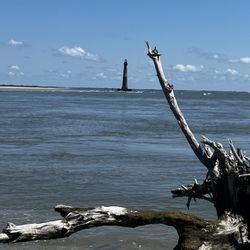
The VERY FIRST bench placed by the Toni Morrison Society honors the memory of both the enslaved Africans who perished during the Middle Passage as well as those who arrived on Sullivan's Island, a major point of entry for Africans who entered the United States during the Transatlantic Slave Trade. About 40 percent of African-Americans alive today can trace their ancestral roots to West Africa through the arrival of slaves @ Sullivan's Island.
I won't go into grave detail about the conditions of slaves during the passage, but if you are interested, here is a link to a narrative describing the voyage: https://www.youtube.com/watch?v=PmQvofAiZGA
It was not uncommon to feed slaves who were sick to the sharks, because a sick slave was ZERO profit for the transporters, but a slave who died during transportation was insured and worth more dead than alive :-(
The remainder of them often arrived here on the shores of Sullivan Island, where they had no control over staying with their families, many of whom were separated forever. Children were often separated as young as 3 years old. Fathers who protested were treated cruelty to subdue any uprising or sold away from their families entirely. Confusion and fear were the main measures of control.
Lineage and tradition were often lost and African cultures combined to form GULLAH-GEECHEE traditions, a melting pot of their various indigenous African traditions from cooking and music, to arts and crafts, to spiritual traditions. They also created a creole language known as Gullah that is not spoken anywhere else in the world and it all began here upon arrival @ Sullivan Island.
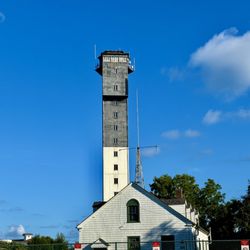
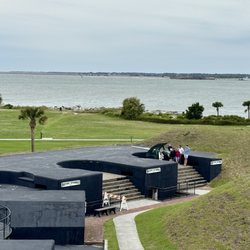
The significance of this entry point and the culture created in this specific corridor (from Jacksonville, FL to Wilmington, NC) is still alive and celebrated today in Gullah Geechee festivals, folklore, foods & time honored traditions. The bench rest in a quiet area behind the Fort Moutrie Visitors Center, beneath an outcrop of small trees overlooking the Sullivan Island Cove.
Many will find this space to be filled with a quiet reflective reverence as you sit and connect with the past in a tangible way, knowing the ancient footsteps who walked here long before us were having a far different experience. I found myself wishing I had brought a single rose, so I could have scattered its pedals on the waters.
***
FINAL THOUGHTS
If I'm being honest, it is very emotionally draining for me to produce a months worth of Black History that you will often not find in typical American schoolbooks. This series is a labor of love for me and while taxing, I hope to enlighten my yelp family to the glory of a magnificent people. Where we have been, where we are and where we are going with no shame to anyone.
I am a black man in American, and through these stories of endurance, I find strengthen and meaning. I hope you will continue all month long with me as I dive deeper into American History of the Black Experience AND celebrate those who are making their way in business and innovation while remembering the past, lest we forget.
2022 / 33