If you find yourself traveling to or through Kansas City, Topeka, or Lawrence, Eagle Bend is not the cheapest public course by far, but it is a well maintained and challenging layout. The first six holes are links-style with undulating fairways surrounded by native grasses (sorry, no gorse) with the final 12 meandering through marshy woodlands surrounding the Wakarusa River.
Prices range from $22 (walking/18 holes/M-F) to $49 (riding/18 holes/weekend) with seniors (60+) and juniors (under 18) getting a slight price break during the week. There are no military or veteran discounts and, oddly enough, no "twilight" or winter rates and "NO DISCOUNTS (PERIOD) ON WEEKENDS". You pay full price no matter what time of year or time of day it is, no wiggle room (more on that later).
The clubhouse is small with a snack bar that seems to do little business, a very limited pro shop, restrooms, a few tables and a couple TVs. I am not sure what capability to snack bar has, but I have never seen anybody sitting in the clubhouse eating a hamburger or sandwich. The pro shop has a small selection of balls and tees, a couple golf bags, and a few gloves, hats and shirts. It does not appear that Eagle Bend's clubhouse is intended to generate much income as far as I can tell and it obviously does not.
The course is very walkable with the exception of the 300-yard treks between the clubhouse and 1st/10th tees and the 1st/10th greens and the 2nd/11th tees. Relatively flat, the only exertion you will encounter are the large gullies in front of the 17th and 18th greens.
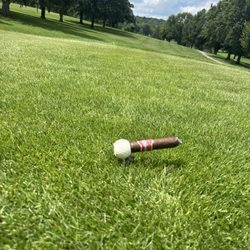
The fairways are Zoysia grass and very well maintained. I have been told that their greenskeeper used to work for a cross-town course, Alvamar, and from what I have observed, they are lucky to have him because their fairways are in much better shape than semi-private Alvamar's Zoysia fairways. If you hit a ball in the fairway, you should have a good lie, a ball that sits-up, and that is normally the case at Eagle Bend. The only exception, strangely enough, is the 18th fairway where the Zoysia stops at the 150 yard marker, leaving a routinely poor lie off of what looks like Perennial Rye grass for your approach shot to the final hole.
The greens are decent and fairly fast, but few people seem to repair their pitch marks, so even the best putt can go astray from time to time. Maybe they could sell, or even give away, inexpensive pitch mark repair tools in the pro shop and post a few signs reminding people to clean up after themselves. Zoysia on the landing area of the 18th would also be a big plus.
There are not a lot of sand traps, but the few they have are strategically placed. The sand is heavy, likely river sand from the nearby Kansas River, leading to difficult shots and inconsistent results for those of us who do not carry a PGA Tour card.
With four sets of tees (gold, blue, white and red), the course is challenging for both sexes and all skill levels. Being close to sixty, I have lost some distance in recent years and find the blue tees a tad too long for my pleasure, so I normally play the whites when I want to enjoy myself. With prevailing winds from the south/southwest, all but four holes are reachable in regulation for the average golfer from the white tes:
Hole #7 - From where the white tees are normally placed, hole #7 (par 4) plays close to 400 yards, normally into the wind, making it very difficult to reach the green even with two good shots.
Hole #8 - A par 3, hole #7 normally plays between 150 and 170 yards directly into the wind with a lake running down the right and a large bunker left of the green, requiring anything from a six iron to a five wood off the tee.
Hole #15 - Very similar to #7, this nearly 400 yard par 4 routinely plays into the wind with native grasses on the left and woods to the right as well as protecting the green on all sides.
Hole #18 - Another 400 yarder from the new, slightly elevated tees, this hole play into the teeth of the wind and has native grasses and woods lining the entire hole. There is a large gully in front of the green with a creek running under and on both sides of the fairway, narrowing to less than 20 yards for any short or errant shot.
When you are a high handicapper or senior and have difficulty hitting a drive over 220 yards with no wind, a par 4 that is 400 yards or a long, well-protected par 3 into the wind makes birdie impossible and par unlikely. From the white tees, 375-385 yards should be the longest par 4 on the course if you want to be fair to the average golfer and speed play.
Otherwise, Eagle Bend is fair and a good challenge as the wind is almost always blowing, swirling and changing directions because of the influence of the Clinton Lake Dam which towers over the west side of the course.
CombatCritic Gives Eagle Bend 7 Bombs Out Of 10 ... More Bombs Are Better! read more