Cancel

Open app

Search

Crossroads Photos

Recommended Reviews - Crossroads

Your trust is our priority, so businesses can't pay to alter or remove their reviews. Learn more about reviews.
Yelp app icon
Browse more easily on the app
Review Feed Illustration
Photo of John M.
664
8732
29661

2 years ago

Helpful 5
Thanks 0
Love this 7
Oh no 0

Verify this business for free

Get access to customer & competitor insights.

Verify this business

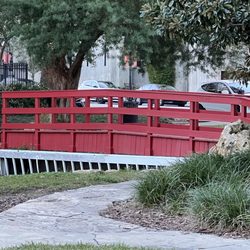
Washington Street Bridge

Washington Street Bridge

(2 reviews)

Lawsona / Fern Creek

Stopping for a minute to read a historic marker is a great way to learn more about the history of…read morean area. I have learned so much from these blue historical markers that can you find all around the state. This particular marker is located in H.H. Dickinson Azalea Park. One side of the marker tells about the park and the other side is about the nearby Washington Street Bridge. During the 1920's, Florida experienced a massive period of growth called the land boom years. As growth moved east in Orlando the little wooden bridge over Fern Creek could no longer with stand the increased vehicle traffic. In July of 1926, the Orlando City Council accepted proposals to replace the bridge. Concrete Steel Bridge Company of Miami Beach was chosen for their $10,400 bid. Orlando City Engineer Morton Hagartney designed a reinforced concrete arch deck bridge with walkways on both sides. The historically inspired light fixtures give the bridge its classical appearance. The bridge isn't very large but it is very pretty and is great for pictures, especially by the lamp posts. The Washington Street Bridge is the only bridge of its kind in the City of Orlando and was designated a Historic Landmark by the city in 1991. In 2014, historic marker F-808 was installed by The City of Orlando District 4 Commissioner Parry Sheehan, Girl Scouts of Citrus Council, Orlando Garden Club, Lake Lawsona Fern Creek Historical Neighborhood Association, Eugene & Lois Pawlak & Family, Dr. Howard Green & Family, The Van De Bogert Family, Deborah Kohan, The Magley Family, Robin & Nancy Lewis, Nancy & Walk Jones, Kathy Wickman, Theresa Smith and the Florida Department of State.

I love discovering these little historical markers that you can see in every city and town across…read morethe country. By seeing the blue historical sign, I learned a little bit more about the history of Orlando. The Washington Street bridge is located on the corner of Washington Street and Rosearden Drive in the downtown section of Orlando. It is right next to Dickson Azalea Park and this new bridge is going on one hundred years old. The bridge was built back in 1926 to replace a deteriorating wooden bridge over Fern Creek and was built for the sum of $10,400. Today, it is the only Bridge of its kind here in Orlando and was designated a Historic Landmark by the city back in 1991. It is hard to imagine what Orlando was like back in 1926. However, this bridge gives us a glimpse of that moment in history. How many people have walked across this bridge since its opening? Orlando is a city that continues to change and progress, but we can never lose sight of the past of the city.

Atlantic Coastline Station Historical Marker

Atlantic Coastline Station Historical Marker

(2 reviews)

South Orange, Downtown South

I love learning about architecture and history so I was immediately drawn to this historic marker…read moreon Sligh Street in Orlando. I am particularly fond of historic train stations, many of which were built during Florida's land boom hey days of the 1920's. Orlando was named in 1857 and incorporated in 1875. In 1880 the first railroad was built to Orlando which at that time was a pioneer cattle and citrus outpost that sprung up from the area around Fort Gatlin, built during the Seminole Wars. Atlantic Coastline Railroad acquired the railroad in 1902 and in an effort to bring more tourism to Orlando, in 1927 they hired architect M.A. Griffith to build on new train station on Sligh street. During the 1920's, Mediterranean Revival was the most popular architectural design choice but Griffith was inspired by his travels along the Pacific Coast where he admired the Spanish architecture and colonial parish churches. The W.T. Hadlow Construction Company of Jacksonville was hired to build the Spanish Mission style building with twin bell towers, arches, parapet, and tile roof at a cost of $300,000. The station was dedicated on January 11, 1927 in front of a crowd of 6,0000 people. On February 27, 1978, the train station was designated an Orlando Historic Landmark. In 2014 the station's original wood doors and windows were restored along with the original building colors. Repairs were also made to the stucco walls, roof, ceilings, paving, and upgrades were made to the restrooms. In 2015, the restoration project won the City of Orlando's Historic Preservation award for Outstanding Commercial Rehabilitation. In 2016 historic marker number F-904 was installed in front of the train station by The City of Orlando and the Florida Department of State. Today the station is considered the largest and finest example of Mission Revival architecture in Central Florida and is the only train station of this style in the state. The station serves Amtrak's Silver Meteor and Silver Star Lines and the SunRail commuter train. I have been to many train stations from the 1920's throughout Florida. Some have been torn down, some are now abandoned, others have been restored and turned into something else like a museum, but it is very rare to see one still being used today. I love that people are still arriving and departing through this historic building. I think M.A. Griffith would be proud to know that the Atlantic Coastline Station is still servicing Orlando's travelers today.

This very well preserved marker is in front of the Orlando Amtrak station and recalls the time when…read morerailroads first started into Florida as well as a certain time in American history and race relations. Certainly well before "Amtrak" was a thing. The marker has text on both sides and it reads: "In 1880, the South Florida Railroad built a railway through Orlando. The small community boomed with land speculators, citrus and cattle investors, and tourists. In 1902, the larger Atlantic Coastline Railroad acquired the South Florida Railroad. Although three earlier Orlando stations were located on Church Street, Atlantic Coastline hired architect M.A. Griffith to design a new station on Sligh Boulevard in 1926. Griffith traveled the Pacific Coast and drew inspiration from Spanish architecture and colonial parish churches. The W.T. Hadlow Construction Company of Jacksonville received a $300,000 construction contract for the Spanish Mission style building. Twin bell towers, arches, parapet, and tile roof reflect this influence. Griffith designed the letters of "ORLANDO" over the west entrance arch. When the station was dedicated in January 1927, it attracted a crowd of more than 6,000 and became an immediate icon. The racially segregated station included a separate waiting room with ticket windows and restrooms for African American passengers on the south side of the building. Built-in curved wooden settees, once featured in both waiting rooms, remain only in the current waiting room." "Known historically as the Atlantic Coastline Railroad Station, this building represented the city's efforts to encourage tourism in Orlando during the 1920s Florida Land Boom. Since its opening, the station has served as a passenger terminal for residents, visitors, and workers. The words "Seaboard Coast Line" on the east arched parapet replaced "Atlantic Coast Line" after the two rail companies merged in 1967. The station was documented by the Historic American Buildings Survey with six drawing sheets archived in the Library of Congress. On February 27, 1978, it was designated as an Orlando Historic Landmark. An extensive renovation began in 2014 to restore the station including the original wood doors and windows. Careful research revealed original colors of the building, window sills, and domes. In 2015, the project won the City of Orlando's Historic Preservation award for Outstanding Commercial Rehabilitation. The station is considered the largest and finest example of Mission Revival architecture in Central Florida and is the only train station of this style in the state. The station serves Amtrak's Silver Meteor and Silver Star Lines and the SunRail commuter train."

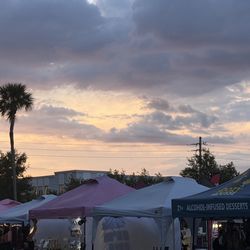
Orlando Festival Park - Festival tents

Orlando Festival Park

(21 reviews)

Colonialtown Center

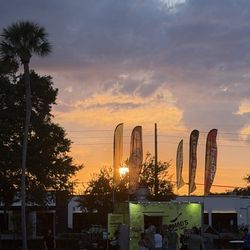
I went here last weekend for the Orlando pickle festival and it was really great experience . The…read morepark is right in the heart of downtown Orlando. There was a nice open space and room for multiple vendors and food trucks . They provided porter potties and hand washing stations which was nice. I will definitely be back for pickle festival next year . I also would love to attend other events too at festival park. I parked in the bealls parking plaza near by to avoid having to pay which was great.

Went here for Panda Fest. It was our first time attending an event at Festival Park. Traffic was…read morepretty snarled up near the venue and parking is difficult, but several places were offering parking for $20 cash. We were able to get parking nearby and walk easily to the event. The park itself is setup well for events. Plenty of open area for booths. They had clear entry and exit areas and security staff to handle entry. The general line was very long, but the security was professional and did their best to move things along. They had porta-potties and mobile real bathrooms in VIP at this particular event. They also had plenty of trash cans. They did need more accessible water for purchase. It was mostly at just the bar huts and those lines were very long. Not good on a hot day when you aren't allowed to bring in your water bottle. The ground is also pretty uneven in spots, so just need to be mindful of that for people with mobility issues. I would go here again for another festival.

City of Orlando - Voodoo Donuts

City of Orlando

(58 reviews)

Downtown / Central Business District / CBD

The city Beautiful! I was born and raised here and grew up…read moreseeing my beloved city transform and thrive. Many things have changed! Old stores and restaurants I grew up with gone and change into something new. Old restaurants I loved still going strong to this day! The sports, the markets, the memories. The city will continue to change, but my love for my hometown will never change. I've traveled many cities and many countries, but I wouldn't want to live too far from my city.

I like Orlando! I visited my childhood best friend when she and her family loved in Orlando. The…read moreonly drawback for me, for Orlando, is I'm not a Disney fan in the least and you can imagine this city, and especially their airport, is rife with mousketeer ears! On our visit to Orlando, we enjoyed the weather, the hospitality, dining out, and in general all that Orlando offers (sans Disney). I'm not knocking Disney, in fact it employs my best friend's (now ex) husband and has for decades! So, hats off to Disney for providing careers and for providing for families' welfare and prosperity. My best friend took a job in South Carolina and now I don't have any friends or relatives in this region nor a pressing need to return since my flights into Orlando were lawya to visit my Sister on the Space Coast and she's moves back to Alabama. Regardless, thanks Orlando for the nice airport, the great memories and the fun visits!

Eppes-Shine Plot Greenwood Cemetery

Eppes-Shine Plot Greenwood Cemetery

(2 reviews)

Greenwood, Downtown South

This is located within Greenwood Cemetery and remembers a respected family that resided here in…read moreOrange County, Florida and can trace their lineage to Thomas Jefferson. I have said it before, but it bears repeating, we need to remember and acknowledge the footsteps from our past that brought us to where we stand today. This was a nice find in the historic cemetery known as Greenwood.

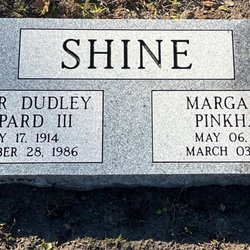
I was exploring the history of Orlando in the historic Greenwood Cemetery when I discovered this…read moremarker dedicated to the Eppes and Shine families buried here. I learned from the sign that they were descendants of Thomas Jefferson who made their mark on early Orlando. Francis Wayles Eppes VII, was 8 years old in 1809 when he spent Christmas in Virginia with his grandfather Thomas Jefferson who had just completed two terms as president. Francis's mother was Jefferson's beloved daughter Maria who died during child birth in 1804 when he was three. His father John Epps was a congressman who remarried and was often away in Washington, DC. so Francis grew up in the care of his grandfather. Francis was the only one of Maria's three children to live to adulthood. Jefferson had set aside the family outpost called Poplar Forest, a 300 acre estate near Lynchburg, Va. for Francis as his inheritance. When Francis turned 15, Jefferson sent him a letter with this advice "Above all things, and at all times, practice yourself in good humor. This, of all human qualities, is the most amiable and endearing to society." Thomas Jefferson died in 1826, when Francis Eppes was 25 and married to Elizabeth with two children. The Jefferson family ended up selling Monticello and Poplar Forest due to debts and legal problems. Francis Eppes landed in Tallahassee with his young family but his wife Elizabeth would pass here during child birth like his mother and two of his seven children died in infancy. Francis Eppes remarried Susan Margaret Ware (1815-1887), the daughter of a governor of Georgia. They lived at Pine Hill, a 1,900-acre plantation, and had six more children, four girls and two boys. Francis Eppes founded St John's Episcopal Church and went on to serve two terms as mayor of Tallahassee in the 1840s and 1850s. He was one of the founders of Florida State University when in the 1850s he helped establish the West Florida Seminary that would become the university where he would serve 11 years on the school's board, eight of them as president. The Civil War hit the Francis Eppes family hard. Eppes sold his land but it was purchased with worthless Confederate money. The family was broke and they moved further south into what would become Orlando, a frontier outpost that sprung up from Fort Gatlin, an outpost during the Seminole Wars. In Orlando Francis Eppes became a citrus farmer. Three of the Eppes daughters married three Shine brothers in 1866. Martha Virginia married Capt. Thomas Jabez Shine, called T.J., Capt. Tom Shine, a Confederate veteran, was the director of the First National Bank, a board of trade officer, an alderman, and commander of the Orlando Guards, later named Shine Guards. In 1879, Thomas built a home on Orange Avenue with the first indoor bathroom in Orlando. The first sidewalk in the city ran past the house and it had a tennis court. He named the cross street Jefferson Street in honor of his wife's family Caroline Matilda married David Shepard Shine who became deputy clerk of Orange County and was appointed postmaster. Caroline and her sister Martha served their communities as members of the Rosalind Club, Sorosis, and with other charities. The third Shine brother Dr. William F. Shine was married to Martha Eppes. Unlike the previous two couples, they did not live in Orlando. Dr. William F. Shine, served as a Civil War surgeon and practiced medicine in St. Augustine after the war. Maria Jefferson Eppes founded the St. Augustine Chapter of the Daughters of the American Revolution which bears her name. Francis Eppes died on May 30, 1881 a few months before his 80th birthday. Francis Eppes and Susan Ware Eppes are buried in Orlando's Greenwood Cemetery in a family plot with members of the Shine family, including T.J. Shine, and their descendants. The Shines are noted for being among Orlando's earliest civic minded families. Marker F-838 was erected in 2014 by The City of Orlando and the Florida Department of State.

John R. Mott House Site - John R. Mott''s house before it was torn down.

John R. Mott House Site

(2 reviews)

South Eola, Thornton Park

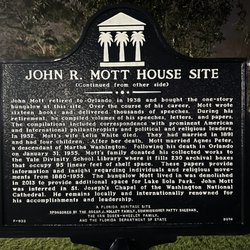
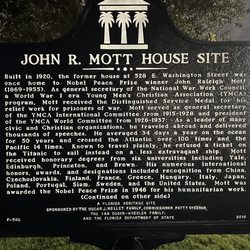
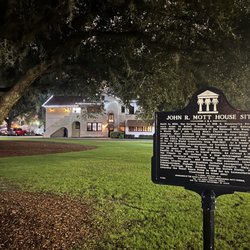
I always stop to read a historical marker if I happen upon one. I have learned so many interesting…read morethings about Florida and its people this way. For some reason I always thought this marker was associated with the historic Eola House which it is near but when you actually stop to read you learn that it was put in place of a home that is no longer here. The John R. Mott House was the former 1920 Mediterranean-style bungalow home of past Nobel Peace Prize-winner John Raleigh Mott. Mott retired to Orlando in 1938 and purchased the home. It was torn down along with three other historic homes in 2013 to expand Lake Eola Park. The homes were known as the The Lake Eola Five. Lake Eola House located near this historic sign was the only one left standing to serve as the Lake Eola Park offices. John Raleigh Mott was a very influential humanitarian figure. He was a leader in the YMCA and the World Student Christian Federation. He helped to found the World Council of Churches in 1948. He held honorary degrees from six universities, including Yale, Edinburgh, Princeton, and Brown. In 1946 he was awarded the Nobel Peace Prize in recognition of his humanitarian work with international Protestant Christian student organizations that promoted peace. Mott authored The Evangelization of the World in this Generation and he became a popular recruiter of college students to foreign mission work. When he was offered free passage on the Titanic he had the good sense to decline in favor of a less luxurious ship more aligned with his austere taste. It was very sad to learn that Orlando tore down four historical homes to basically have a field where they can hold events in the downtown area. The bungalow was especially cute and attached to a historical figure. It could have served as museum. To ensure that Mott would not be forgotten, in 2017, the city of Orlando placed a two sided Florida Historical Marker F-932, at the site of where Mr. Mott's home once stood, in recognition of his life's work. The marker was paid for by Commissioner Patty Sheehan along with private donations from he Van Dusen and the Nollet families. One star for Orlando tearing down Mr. Mott's home and five stars for all of John R. Mott's great work.
The John R. Mott House Site is a piece of Orlando, Florida history located by a plaque on the edge…read moreof Lake Eola Park. It commemorates the house site of John Raleigh Mott, who was a Nobel Peace Prize recipient. In addition, Mott was awarded the Distinguished Service Medal for his relief work for prisoners of war. Whenever I see a local historic plaque, if possible, I pull over and check it out. We individually and as a society need to remember our history, the steps that brought us to where we stand today. Our society would not be what it is today had it not been for pioneers like this gentleman who strived to make the world a better place. I am grateful that I discovered this cool piece of history and I give it five stars.

Crossroads - landmarks - Updated May 2026

Loading...
Loading...
Loading...