Cancel

    Open app

    Search

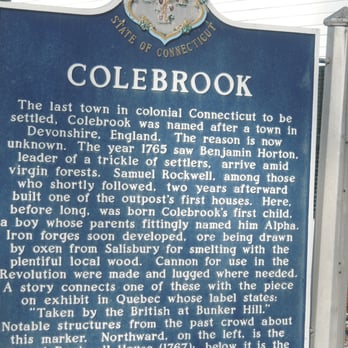
    Colebrook Historical Marker

    4.0 (1 review)

    Colebrook Historical Marker Photos

    Recommended Reviews - Colebrook Historical Marker
    Your trust is our priority, so businesses can't pay to alter or remove their reviews. Learn more about reviews.
    Yelp app icon
    Browse more easily on the app
    Review Feed Illustration

    12 years ago

    Helpful 21
    Thanks 0
    Love this 21
    Oh no 0

    Verify this business for free

    Get access to customer & competitor insights.

    Verify this business

    Winchester Center Historical Marker

    Winchester Center Historical Marker

    4.0(1 review)
    6.5 mi

    This is one of those state signs in every town, village, and "used to have people living here"…read moreplace in Connecticut. Winchester Center is closest to the la as t of those categories. It's very pretty, and people do live there, but if you need a bottle of milk you're driving at least 20 minutes. Anyway, it does warrant itself a sign from the state, titled "Winchester Center, 'The Old Society'" and reads: The first ecclesiastical society of Winchester was incorporated by the central assembly of the colony of Connecticut at its May session, 1768. The following year, a small, low, steeple-roofed building was erected for a meeting house about 7/10 of a mile south of the present Winchester Center Green;a rough granite post marks the site. The first census of the colony, taken in 1756, has 24 as the population of the entire town of Winchester. The next census, taken in 1774, shows 327 whites, 12 blacks. The Congregational Church was formed October 30, 1771, with 14 members. Only five years after the erection of the first house of worship, a committee was sent from the county court at Litchfield "to pitch the stakes" for a meeting house at the 'center'. On October 11, 1785, Dr. Josiah Everett deeded to the society for the sum of 1 £, 16s and 3d "lawful money" for a certain piece of land containing 56 1/2 rods "to build a meeting house on for divine worship, and for a suitable green around the same." In 1786 a new edifice was erected on this Green. The whipping post and stocks, those indispensable pillars of New England law and order, stood nearby on the green. The post served also for the posting of public notices. The third church, Greek revival with a Doric portico and facade of matched boards, was erected in 1841. Just north of the green, land was provided by 'Squire' Issac Bronson; with the stipulation that no building was ever again to be erected on the green. Our father's built shelter for their families and stock, then the church of God, then the school house. The early records of the town do not contain any accounts of building the first public schoolhouse. However, there is no doubt such buildings were erected. The 'chapel', across Winchester road from the church, began its existence as 'the Academy' finances by a group of investors "who purchased rights payable in higher education for their children." The Winchester institute (which stood some 700 north of the center green) a commodious seminary building opened in 1858 as a boarding and day school. It was the seat of learning for such great men as Dr. Fredrick S. Dennis and Dr. William H Welch (the latter discovered "ether"); after use as a seminary it became The Hill View Inn (destroyed by fire in 1929). The center had at one time two country stores, the Bronson Bros at the north side of the Green and S&L Hurlbut on Newfield Road. The latter building was acquired in 1895 by the Winchester Grange. Fire destroyed it in 1951 and the present grange hall was its replacement. The Winchester Center cemetery, acquired Mar. 16 1773 and the Hurlbut family cemetery are on South road, about a mile south east. The Danbury Courier cemetery is on Benedict road part of the original Winchester Center Settlement. You can park across from the sign near the Grange hall, and dash across and see it. The sign itself is on a small triangle of land, and you'll undoubtedly be in the way of cars if you try to park there.

    Photos
    Winchester Center Historical Marker
    Winchester Center Historical Marker
    Winchester Center Historical Marker

    See all

    Winchester Soldiers' Monument - Winchester Soldiers' Monument

    Winchester Soldiers' Monument

    5.0(2 reviews)
    4.6 mi

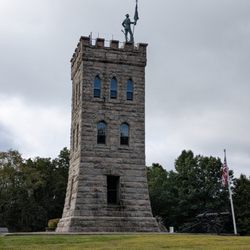
    I passed through Winchester a few years ago and missed this so on my next trip through Connecticut,…read morethis had to be a stop. This striking Civil War memorial blends Gothic architectural drama with deep civic pride. Its story spans decades of community effort, artistic vision, and historical reverence. The monument is a three-story Gothic-style tower built of locally quarried ashlar granite. Designed by Robert W. Hill of Waterbury, it features a square base with inward-sloping lower walls that straighten as they rise, crowned by crenellations. A circular tourelle projects from one corner of the third level, topped by a bronze figure of a Civil War soldier holding the colors - sculpted by George E. Bissell. The tower stands 44 feet tall and was originally intended to include an iron staircase, but a contractor dispute led to a temporary wooden one instead. Over time, additions included a square entrance arch, stone retaining walls, cannons, and a decorative fountain by Hartford sculptor Andrew Coppola in the 1970s. It is a challenge getting up the hill to the park but once here, you'll appreciate the tower and the view. [Review 1142 of 2025 - 130 in Connecticut - 24695 overall]

    Magnificent and awe inspiring…read more Two days ago, I reviewed the incredible Sailors and Soldiers Memorial Arch in Hartford. It was spectacular!! Little did I imagine that 48 hours later, and just 26 miles away, I would see another mind blowing veteran's monument that defies belief. The Winchester Soldiers' Monument is set way up high on a hill in a small park on Crown Street in Winsted. The land it sits on was donated in 1888 by three local gents to establish some sort of Civil War memorial and park. And what a memorial it turned into! They built a three-story granite castle that's over 40 feet tall. And what sits atop the tower? Why an 8' tall bronze statue of a Civil War soldier wearing a jacket and a hat, with a sword on his belt, and holding a flag. The Monument was dedicated on September 11, 1890. Special trains ran out of Hartford to bring a crowd of 20,000 to be a part of what the Hartford Courant described as "Winsted's Glorious Day." The Memorial Park is used for town celebrations and Veterans and Memorial Day ceremonies. Picnics, concerts, plays, religious ceremonies, and weddings are held here. What's pretty cool is that the image of the monument is an essential component of the Winchester Town Seal and the badges of it's police force. When you stand up on the hill, with the statue behind you, you get the impression that the soldier is standing guard, on a never ending vigil to protect his town. This one will give you the chills............

    Photos
    Winchester Soldiers' Monument - Winchester Soldiers' Monument

    Winchester Soldiers' Monument

    Winchester Soldiers' Monument - Winchester Soldiers' Monument

    Winchester Soldiers' Monument

    Winchester Soldiers' Monument - Winchester Soldiers' Monument

    See all

    Winchester Soldiers' Monument

    Norfolk Historical Marker

    Norfolk Historical Marker

    4.0(1 review)
    5.3 mi

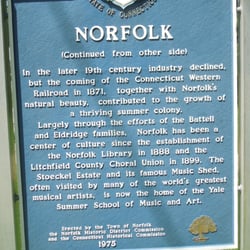
    Some of the early settlers of Norfolk worked in the mills. Some were farmers and blacksmiths…read more But in, April of 1775, they became American patriots and soldiers as they marched 136 miles to Boston to take up arms against the British. By the time of independence, over 150 of Norfolk's men had fought in the Revolutionary War. Located on a village green where Routes 272 and 44 intersect, this is a two-sided marker from the CT Historical Commission in the familiar white lettering on a blue background. It dates to 1975 and is in very good condition. The full inscription reads: Norfolk In the heart of the Green Woods on what was later the Hartford-Albany Turnpike, Norfolk was settled in 1744 by Cornelius Brown of Windsor. The town was incorporated in 1758 with forty-four voters at the first town meeting. A meeting house was built, and in 1761 the Reverend Ammi R. Robbins became the first minister, serving for fifty-two years. Twenty-four men from Norfolk marched to aid Boston in April, 1775, and over one hundred and fifty fought in the Revolutionary War. The early settlers were farmers, erecting sawmills, gristmills, and blacksmithies for their own needs. Using the waterpower of the Blackberry River, the town became industrial in the 1800's, manufacturing such diverse products as linseed oil, men's hats, woolens, cheese boxes, scythes and hoes. In the later 19th century industry declined, but the coming of the Connecticut Western Railroad in 1871, together with Norfolk's natural beauty contributed to the growth of a thriving summer colony. Largely through the efforts of the Battell and Eldridge families, Norfolk has been a center of culture since the establishment of the Norfolk Library in 1888 and the Litchfield County Choral Union in 1899. The Stoeckel Estate and its famous Music Shed, often visited by many of the world's greatest musical artists, is now the home of the Yale Summer School of Music and Art. Erected by the Town of Norfolk the Norfolk Historic District Commission and the Connecticut Historical Commission 1975

    Photos
    Norfolk Historical Marker

    See all

    Hollow Church Bell

    Hollow Church Bell

    4.0(1 review)
    8.2 mi

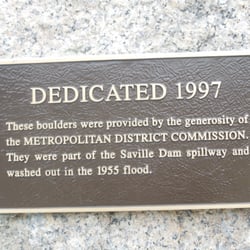
    Driving through the pretty countryside in Barkhamsted, I came across quite an unusual site - a…read morelarge metal bell sitting on top of two imposing stone pillars. The monument sits between two huge flagpoles, almost giving it the appearance of sitting inside a set of football goalposts. The bell is located on a green at the intersection of Pleasant Valley Road (Connecticut Route 318) and Beach Rock Road, adjacent to the Barkhamsted Center Cemetery. So here's the history of the bell. It's old - like 1834 old. It's from an old Barkhamsted Church named the Universalist Church. It was in the part of town known as Barkhamsted Hollow, so the Church was also known as the Hollow Church. Because the area was prone to floods, the immediate area was redesigned by the MDC in the late 1930's as many houses, farms, and that very Church were razed to build the Saville Dam in 1940. The Dam was meant to keep the nearby Farmington River in check and created the huge Barkhamsted Reservoir. The stone pillars contain two inscribed plaques that read: This bell hung in the Hollow Church which was relocated during construction of the Compensating Reservoir. It was cast in Hartford, CT in 1834. Dedicated 1997 These boulders were provided by the generosity of the Metropolitan District Commission. There were part of the Saville Dam spillway and washed out in the 1955 flood. It's quite the cool landmark, Reminds me of an old Chuck Berry song about some guy........"who never ever learned to read or write so well, but he could play the guitar like ringing a bell...."

    Photos
    Hollow Church Bell
    Hollow Church Bell
    Hollow Church Bell

    See all

    Colebrook Historical Marker - landmarks - Updated May 2026

    Loading...
    Loading...
    Loading...