St Philip, Earl's Court Road, is technically in Kensington (being north of Cromwell Road) but is so…read moreclose to Earl's Court, that it is usually thought of as serving the latter.
The church is celebrating its 150th anniversary this year, and it has had an interesting, not to say fairly chequered, history over the years.
It was built in 1857-8 to the designs of Thomas Johnson of Lichfield, and substantially enlarged in 1863. Its origins are tied up in the complex pattern of church building in 19th century Kensington, which saw Church of England churches built at an extraordinary density, even for London: as the area grew, existing churches of different styles of worship vied with each other to establish new church plants: the Survey of London lists no fewer than seven in the area between Earl's Court and Kensington Square, an area of rather less than two square miles.
St Philip's was an offshoot of St Barnabas, Addison Road, and began life as a rented room at the corner of Warwick Gardens and Pembroke Gardens, to cater for the area's rapidly growing population. A church seating 1,000 - for a population of 2,500 (!) - was proposed, and built in under a year.
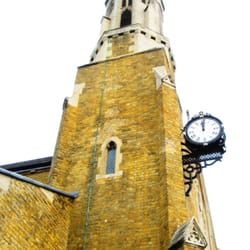
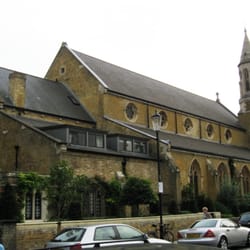
The style is late Decorated Gothic, and executed in yellow stock brick with stone dressings. As built, it had a five-bay nave with north and south aisles, and a south porch, and a thin bell tower. The clerestory has attractive circular windows, variously with sexfoil, trefoil or rosette tracery.
As the population expanded, Johnson was called upon to design an enlarged south aisle with a gallery, to provide an extra 400 seats. This was completed in 1863, the south aisle being enlarged to the same size as the nave. A reredos of Caen stone and alabaster was also installed at this point, along with a font.
The church entered a period of decline after 1877, partly due to the unpopularity of the Vicar, Walter Pennington, described by a contemporary source as 'a disgrace to his sacred office'. However, the decline must also be attributed to the building of two new churches within the parish: St Matthias's, Warwick Road, and St Cuthbert's, which inevitably attracted some of St Philip's congregation.
After his departure, the new vicar, William Smale, paid for repairs and improvements, including decoration of the sanctuary. Further improvements came just before the First World War, when a new organ was installed, along with an impressive reredos in a late mediaeval style by Sir Walter Tapper (1861-1935), an assistant of the famous Church architect G F Bodley, and architect of The Annunciation, Marble Arch. The only major change thereafter was the replacement in 1966 of those stained glass windows destroyed during the Second World War.
The church underwent a major rebuilding programme in 2005 to convert the chancel and various outbuildings to housing, and the south aisle to provide a parish hall below and offices above, and the brick interior has been painted cream throughout.
This has radically altered the internal appearance, although key features of the architecture, such as the nave arcades, have been retained. The East Window has been installed as a 'false window' above the High Altar, and backlit; elsewhere, the original windows and their glass have been retained, and the impressive reredos - easily the best furnishing - now forms the backdrop of a Chapel in the north aisle.
Modern (and comfortable) seating has been installed, along with (slightly more dubiously) very futuristic high-tech grey metal chandeliers. But, overall, it presents an attractive worship space, if one which is very different in feel from the original.
The style of worship is traditional middle-of-the-road Anglican, with a very active Sunday School and a small but friendly congregation. The church is now organised as part of the team ministry of St Mary Abbots, Kensington.