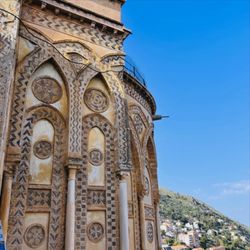
The Cathedral of Monreale is one of the greatest preserved examples of Norman architecture in the world. It was begun in 1174 by William II, and in 1182 the church, dedicated to the Assumption of the Virgin Mary, was, by a bull of Pope Lucius III, elevated to the rank of a metropolitan cathedral.
The church is a national monument of Italy and one of the most important attractions of Sicily.
The archiepiscopal palace and monastic buildings on the south side were enormous, surrounded by a massive precinct wall, crowned at intervals by twelve towers. This has been mostly rebuilt, and little now remains except ruins of some of the towers, a great part of the monks' quarters, and the splendid cloister, completed about 1200.
This last is well preserved, and is one of the finest Italian cloisters both for size and beauty of detail. It is about 16 m, with pointed arches decorated with diaper work, supported on pairs of columns in white marble, 216 in all, which were alternately plain and decorated by bands of patterns in gold and colours. The marble caps are each richly carved with figures and foliage, no two being alike.
The church's plan is a mixture of Eastern Orthodox and Roman Catholic arrangement. The nave is like an Italian basilica, while the large triple-apsed choir is like one of the early three-apsed churches, of which so many examples still exist in Syria and other Oriental countries. It is, in fact, like two quite different churches put together endwise.
The basilican nave is wide, with narrow aisles. Monolithic columns of grey oriental granite (except one, which is of cipolin marble), evidently the spoils of Antique buildings, on each side support eight pointed arches much stilted.
The other half, Eastern in two senses, is both wider and higher than the nave. It also is divided into a central space with two aisles, each of the divisions ending at the east with an apse. The roofs throughout are of open woodwork very low in pitch, constructionally plain, but richly decorated with color, now mostly restored. At the west end of the nave are two projecting towers, with a narthex (entrance) between them.
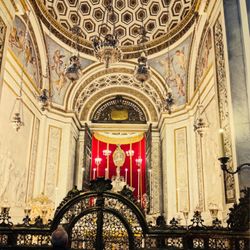
It is, however, the large extent (6,500 m) and glittering splendour of the glass mosaics covering the interior which make this church so splendid. With the exception of a high dado, itself very beautiful, made of marble slabs with bands of mosaic between them, the whole interior surface of the walls is covered with minute mosaic-pictures in brilliant colors on a gold ground. The mosaic pictures are arranged in tiers, divided by horizontal and vertical bands.
The tomb of William I of Sicily and the founder William II's tomb, erected in 1575, were both shattered by a fire, which in 1811 broke out in the choir, damaging some of the mosaics, and destroying all the fine walnut choir-fittings, the organs, and most of the choir roof. The tombs were rebuilt, and the whole of the damaged part of the church restored. On the north of the choir are the tombs of Margaret of Navarre, wife of William I, and her two sons Roger and Henry, together with an urn containing the viscera of Saint Louis of France, who died in 1270. read more