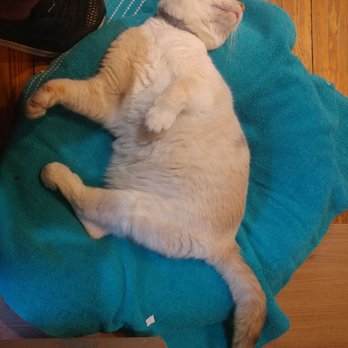
I am writing this to warn other pet owners. Our beloved 22-year-old cat, Snowbear, who also had…read moreStage 2 kidney disease, passed away just hours after a procedure at this clinic due to what we believe was severe medical negligence by Dr. Jackie Holmes.
On March 30th, we took Snowbear for a consultation regarding a lump. Despite his extreme age and kidney condition, Dr. Holmes suggested an immediate dental extraction. She claimed there was "very little risk." We explicitly told her he had eaten that morning and had finished a full bowl of Hydracare mixed with wet food overnight. We asked if we should come back another day since he hadn't fasted, but she dismissed our concerns, saying, "I have some time, we can do it now," and "should be fine." We trusted her professional judgment, but it was a fatal mistake.
What makes this even more troubling is that, according to the medical records, this reassurance was given before any bloodwork results were available. Snowbear was over 21 years old and had known Stage 2 kidney disease. Yet we were told the procedure carried very little risk before any laboratory evaluation had been reviewed.
The bloodwork performed that day later showed that Snowbear's condition had worsened compared to previous testing. His creatinine had increased from 2.2 to 2.5, his hematocrit had dropped from 35.46% to 29.82%, his hemoglobin had fallen from 11.9 to 9.9, and his potassium had decreased from 4.1 to 3.6. These changes suggested a significantly less stable patient than we had been led to believe.
Even more concerning, the timeline documented in the medical records raises serious questions. The anesthesia record shows anesthesia beginning at 11:55 AM and intubation occurring at 12:00 PM. However, the bloodwork results are timestamped approximately 12:01-12:03 PM. This raises the possibility that Snowbear was anesthetized before the bloodwork results were available and reviewed. If true, that means a 21-year-old cat with kidney disease was placed under general anesthesia before the veterinarian had reviewed the very tests needed to assess anesthetic risk.
As a veterinarian with decades of experience, Dr. Holmes should have understood that a patient of Snowbear's age and medical condition required the highest level of caution. Instead, the decision to proceed appeared rushed and made without a complete understanding of his condition that day.
The procedure was rushed, and Snowbear was cleared for discharge only about 15 minutes after waking from general anesthesia. Dr. Holmes never told us to keep a close eye on him or warned us of potential complications. Shortly after we followed her instructions to give him Buprenorphine at home, he collapsed. We rushed him to the ER, he didn't make it.
This wasn't just "old age." This was a rushed surgery performed on a non-fasting, senior patient with known kidney disease, followed by inadequate post-operative monitoring and discharge shortly after recovery. Our hearts are broken. Please think twice before bringing your pets here.
We are beyond devastated. He is our precious boy and has been with us since before our marriage. Snowbear was far more than just a pet; he was a constant, living thread woven through the very fabric of our lives. He was there through every joy, every sorrow, and every major milestone we experienced. He was our family, our anchor, and a part of our souls. To lose him so abruptly due to what we believe were preventable decisions is a pain beyond words. We cannot imagine our lives without him, and the void he leaves behind is immeasurable.
The two attached photos were taken on the day he went to see the vet.