Cancel

Open app

Search

Casselberry Photos

Recommended Reviews - Casselberry

Your trust is our priority, so businesses can't pay to alter or remove their reviews. Learn more about reviews.
Yelp app icon
Browse more easily on the app
Review Feed Illustration
Photo of Ariel W.
4396
5923
104159

11 months ago

Helpful 24
Thanks 7
Love this 20
Oh no 0
Photo of John M.
664
8768
29897

2 years ago

Helpful 8
Thanks 1
Love this 6
Oh no 0

Verify this business for free

People searched for Landmarks & Historical Buildings 181 times last month within 5 miles of this business.

Verify this business

Hedy Lemarr Historical Marker

Hedy Lemarr Historical Marker

5.0(2 reviews)
3.2 mi

While I am very familiar with the blue markers of the state wide Florida Historical Marker Program,…read moreoccasionally I will come across a county or city historic marker. On a recent walk through Red Bug Lake Park, I discovered that Seminole County has their own historic marker program. Historic markers are a great way to learn about the formative people, buildings, and events in Florida's history. This marker was erected in 2023 by The Jewish American Society for Historic Preservation with support from the Casselberry Historical Society and the Seminole County Historical Society. It recounts the important WWII contributions made by the actress Hedy Lamarr who passed away in Casselberry at the age of 85 on January 19, 2000. According to this marker, famed Golden Age of Hollywood actress and inventor Hedy Lemarr had a home near Red Bug Lake Park in the later years of her life. Hedy was born Hedwig Eva Marie Kiesler on November 9, 1914, in Austria to Emil and Gertrude Kiesler and she was raised in the Jewish faith. In 1938 she came to the U.S. and became a naturalized citizen in 1953. She went on to star in two dozen movies, including the notable Samson and Delilah directed by Cecil B. DeMille. During WWII, Hedy and George Antheil received U.S. patent number No. 2,292,387 for their Secret Communication System. Hedy explored potential military applications for radio technology. She theorized that varying radio frequencies at irregular intervals would prevent interception or jamming of transmissions, thereby creating an innovative communication system. Together she and Antheil designed a way to help the U.S. Navy against Nazi Germany by allowing spread spectrum and frequency jumping of radio waves in torpedo guidance systems. This technology was later used to make Wi-Fi, GPS, and Bluetooth technology possible. The National Inventor's Hall of Fame posthumously inducted Lemarr and Anthiel in 2014. Her invention has led Heddy Lamar to be known as the mother of Wi-Fi.

Who knew that Hedy Lemarr had a connection to Oviedo, Florida? I certainly did not until today as I…read morewas walking around Red Bug Lake Park and came across this historical marker. Hedy Lamarr was n incredibly popular actress back in the golden age of film making. She starred in over two dozen movies including the Cecil B. DeMille classic "Sampson and Delilah." What many do not realize is that in addition to her beauty, Hedy Lamarr was not only incredibly intelligent, but she was also the co-onventor of a "secret communication system," which allowed frequency jumping in radio waves. This later was beneficial with WiFi and cellular phone technology possible. It appears that Lamarr relocated to the Oviedo, Florida area and this is where she passed away back in 2000. I love finding these historical markers that connect us to a community's past.

Photos
Hedy Lemarr Historical Marker
Hedy Lemarr Historical Marker - Hedy Lamarr

Hedy Lamarr

Hedy Lemarr Historical Marker

See all

White’s Wharf Clifton Springs

White’s Wharf Clifton Springs

5.0(1 review)
6.3 mi

While I am very familiar with the blue markers of the state wide Florida Historical Marker Program,…read moreoccasionally I will come across a county or city historic marker. On a recent walk through Overlook Park on Lake Jessup, I discovered that Seminole County has their own historic marker program. Historic markers are a great way to learn about the formative people, buildings, and events in a town's history. This marker was erected by Seminole County and recounts the history of White's Wharf at Clifton Springs. Just north of this spot, in 1765-1766 John and William Bartram discovered the springs during a search for the source during their excursion up the Saint Johns River. They set up camp next to the warm sulfur springs. The swampy shoreline of Lake Jessup became the site of at least three wharves and trading posts just after the Civil War. In the late 1870's, W.G. White built a store at this spot. White employed six clerks and traded with buyers who came by wagon and ox cart from all parts of Central Florida and as far south as Fort Christmas. Settlers gave meat, hides, and plumes from wild birds in exchange for flour, grits, cane syrup, molasses, rice, medicines, cloth, and hardware. White also owned a nearby grove that supplied his wharf. White's Wharf became an important stop for anyone traveling on the St. John River and those in the new city of Oviedo. The campground at White's Wharf became a community gathering place for church picnics until the 1950's. The site also became known as Clifton Springs, in honor of the hometown in New York of Dr. Henry Foster, a wealthy grower who spent winters at Lake Charm in Oviedo. In 1882, White formed the Lake Jessup Steamboat Company with the local postmaster and another merchant. The men purchased the Isis, a stern-wheeler that hauled fruit from the grove across the lake to the St. Johns and north to Jacksonville which boosted the popularity of Clifton Springs. The Isis eventually sank in Lake George during a bad storm, killing three crewman. The Lake Jessup Steamboat Company soon disbanded after the ship was destroyed. In the 1800's White moved his business to Orlando to take advantage of the railroads being built in Central Florida. In the early 2000's, Seminole County claimed this land and renamed White's Wharf to Overlook Park and opened it to the public. The park is surrounded by two sulfur springs, one to the east and one to the west. There is a picnic pavilion and a boardwalk on Lake Jessup for fishing.

Hannibal Square

Hannibal Square

4.3(6 reviews)
5.3 mi

Hannibal Square is a historic district in Winter Park on New England Avenue two blocks west of Park…read moreAvenue, between Virginia and Pennsylvania Avenues. Winter Park sprang up around a railroad track laid in 1880 by the South Florida Railroad that connected Orlando to Sanford. Hannibal Square was founded in 1881 as an African-American community of laborers who built the town and worked as domestic servants to the areas wealthy families. The people who lived in Hannibal Square had educational opportunities, prosperity, and professional standing. The railroad tracks served as the dividing line in the town with whites living on the east side and blacks to the west. While visiting Hannibal Square I enjoyed taking in the charming architecture, Shady Park, the Hannibal Square Heritage Center, restaurants, and shops. Hannibal Square is not as busy as the Park Ave area of town but it is still near enough to it that you could easily walk there.

2019 Review 47/100 A…read moregreat little area in Winter Park. Worth stopping by if you're strolling down Park Ave (it's only a few blocks away). Hannibal Square is lined with a variety of great restaurants and cool shops (Rifle Paper Co. is my fave!). It's much smaller than Park Ave. And almost never as crowded. So it's great if you're looking for a chill "Winter Park experience" without the hustle and bustle of Park Ave. Plus parking is always much easier. I usually park in Hannibal Square on Saturday mornings and go for a nice run through the Square up to Park Ave and walk around the Winter Park Farmers' Market.

Photos
Hannibal Square
Hannibal Square
Hannibal Square

See all

Downtown Winter Park Historic District - The annual Christmas parade.

Downtown Winter Park Historic District

4.9(14 reviews)
5.2 mi

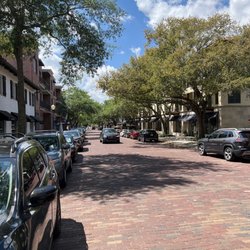
The Winter Park Downtown Historic District is a fantastic neighborhood with its roots tracing back…read moreto 1881. The neighborhood has some great restaurants and shopping options and is close enough to downtown Orlando to make it convenient, yet far enough away to embrace its own identity and be a lot more laid back. The streets are cobblestone and just adds to the ambiance. This is a nice upscale neighborhood and gives a cool, almost small-town feel in the midst of the city of Orlando, Florida. I would definitely recommend a visit to this cool neighborhood.

Winter Park began as 8 acres of land purchased by David Mizoram Jr. in 1858 who called his purchase…read moreLakeview. The town of Winter Park was plotted when Loring Chase and Oliver Chapman purchased 600 acres in 1881. Life was given to the new town when the railroad was persuaded to extend it's line. The railroad depot built in 1882 was the towns first building. A store was built at Park Ave and Morse Blvd that housed a mercantile, post office, and assembly room. The building still stands. The town was chartered in 1887 and became a retreat for wealthy northerners looking to escape the cold climate in the winter, hence the name of the town Winter Park. The towns economy was built on entertaining winter tourists. Rollins College, the oldest college in Florida was founded here in 1885. The city was incorporated in 1925 and is governed by four city commissioners and a mayor. Today Winter Park is 9 square miles and home to approximately 28,500 residents. The town is known for it's lakes, parks, museums, and shops and restaurants along historic Park Avenue. My favorite restaurant is the Briar Patch. The Winter Park Historic District includes buildings constructed from 1882 through 1965, and it runs along Park Avenue from Canton to Comstock Avenues. Winter Park has held on to its old small town charm. Popular past times here include a boat ride on Lake Osceola, a meal on Park Avenue, and a trip to the Morse Museum. Favorite festivals include the Winter Park Sidewalk Art Festival and the 4th of July Celebration in Central Park. The Winter Park Historic District is a delightful mixture of the new and the old and just like in the 1800's you can still arrive by train.

Photos
Downtown Winter Park Historic District

See all

The Phoenix - She growing up!

The Phoenix

5.0(2 reviews)
3.4 mi

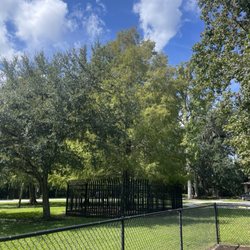
Located in Big Tree Park near the parking area and playground is a landmark bald cypress tree, The…read morePhoenix. Bald Cypress trees are a deciduous tree found in swamps, wet stream banks, and bottom lands in the southern part of the United States. They can reach heights of 80-130 feet and diameters of 8-13 feet. Cypress trees belong to the large group of plants called conifers meaning they produce cones that hold their seeds. Cypress wood is very durable resisting rotting and pests making it a popular choice for fences, docks, and other outdoor structures. Cypresses trees are also found in gardens and parks. They are notable for being one of the very few trees that can survive in standing water. What makes The Phoenix tree so special is that it is a clone of another cypress tree that used to be in the park, The Senator. The Senator was the Florida state champion Bald Cypress tree and was 3,500 years old. On January 16, 2012, The Senator was burned down in an arson fire by Winter Park resident, Sara Barnes. Some of the wood from The Senator was given to artists and you can see the pieces they created in the Seminole History Museum. Before The Senator was lost, the forward thinking Mr. Laymond Hardy, a high school teacher with a strong interest in cypress, worked with Mr. Marvin Buchannan of Central Florida Lands and Timber Nursery and Dr. Donald L. Rockwood of the University of Florida, to develop a seed orchard of selected cypress trees in the 1990's. Mr. Hardy thought to include The Senator and collected several of its branches for cloning. Branches were grafted onto root stock, propagated, and The Phoenix was planted in the park in 2013. The Phoenix has the exact genetic makeup of The Senator. Local schoolchildren chose the name The Phoenix after the bird that rises from the ashes. While the story of The Senator is a tragic one, The Phoenix represents new hope.

I remember when we lost the Senator and the Phoenix was first planted. Just a little sprig of wood…read morewith a fence around it. But look at her now!!!! She's growing up strong and getting bigger everyday. She's right next to the playground at the entrance of the park and is already home to so much wildlife. This is a big part of recent Florida history so bring your kids by to play on the playground and see the tree that has survived incredible odds! I am so proud of the Phoenix and give high praise to Florida for the tribute they have created for the Senator.

Photos
The Phoenix
The Phoenix
The Phoenix - The Phoenix

See all

The Phoenix

Casselberry - landmarks - Updated May 2026

Loading...
Loading...
Loading...