Cancel

Open app

Search

Burgh Chambers Photos

Recommended Reviews - Burgh Chambers

Your trust is our priority, so businesses can't pay to alter or remove their reviews. Learn more about reviews.
Yelp app icon
Browse more easily on the app
Review Feed Illustration
Photo of Jane T.
24
1521
3389

14 years ago

Helpful 0
Thanks 0
Love this 0
Oh no 0

Verify this business for free

Get access to customer & competitor insights.

Verify this business

Thirlestane Castle Trust - from wikipedia article attributed : Kevin Rae( free share and use)

Thirlestane Castle Trust

(4 reviews)

Definitely recommend! The tour guide Lesley is very friendly and helpful. The rooms are beautiful…read moreinside, and you can take photos and videos. Super interesting to hear the history of the castle! Can take an uber from Edinburgh, but will have to call a private car for a ride to the closest train station.

I chose a lovely day to visit Thirlestane Castle in Lauder in the Borders in Scotland.Its easily…read moreaccessible from Edinburgh or even Newcastle. From Edinburgh, it takes you about an hour to get there, down the A68. The castle is located on the Lauderdale estate and nowadays is part of a trust. It's a fairy tale castle and has been in the possession of the Maitland family for over 500 years. One part of the castle is still lived in by the current family, the Duke of Lauderdale. The family tree I'd displayed in one of their rooms and you will notice family connections with other famous aristocratic families like the Dysart's, Home, Lauder, Ogilvie etc The castle is definitely worth a visit. There are many rooms to explore, one grander than the previous. Must confess that my most favourite piece in the castle was an amazingly well preserved toy, a children's play mansion. I have never seen such a grandiose master piece. Every room in this miniature mansion was filled with dolls, furnishings and any possible accessories you can imagine! The staff in the castle are very kind, knowledgeable and very proud of its historic value. There is a small gift shop and a lovely tea room. The tea shop interior is very colourful and warm. They offer plenty of food choices. Sometimes, the service felt a bit chaotic, but they made it up with their very kind attitude. The estate is vast, but I did not get the impression that there is much to explore in the gardens (in the back) However, there is a playground for the children, a large picnic area and a woodland walk that also leads you to the lower car park. Check out their website. There might be some events on that you might like. When I was there they had lots of Rovers (mostly old timers) displayed in the front garden and people were really proud of their cars. This place had lots of character and it's pride in heritage! It's worth a visit - don't miss out! I will be back!

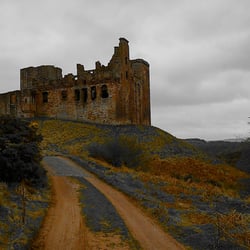
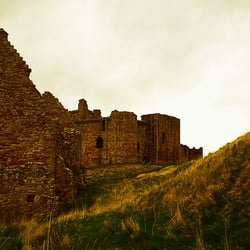
Crichton Castle

Crichton Castle

(2 reviews)

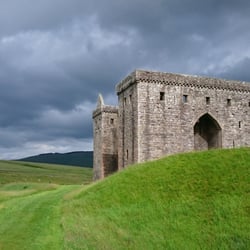
I'm literally speechless how awesome this place is and not to mention its remote location makes it…read moreone jewel of its kind. Crichton castle is kept and maintained by Historic Scotland and only open to visitors from April to September. Entry for non members is about £4.50. There is a small car park not far from the castle and a 10 min walk to get to the main castle entrance. The scenery surrounding the castle is awe inspiring. No need to hurry, just walk slowly, take in the amazing scenery and breath the fresh air. I believe the tower was build in the 14th century by John Crichton. His son became a very powerful magnate in Scottish history and started the castle's extension. During the 1600's the castle changed hands and later was neglected and became a ruin. The inside is not large and you can get around very quickly. You can see the italian style inpired inner wall, the old ruined tower, a well, wonderful views surrounding the castle and various chambers. It was a windy day and the walls offered me shelter.I could also listen to the sounds of pigeons giving the place a mystic background. There is a keeper who watches the place and ensures that the entrance is paid. He is a lovely soul. Outside I walked down to the stables that sheltered the horses. Needless to say, the horses were spoilt :-) Above the entrance you can still see a horseshoe imprint. Behind the stable starts a hiking path. Best you wear ideal shoes for the adventure. I defo will be back and a picnic will definitiely be on the cards as well as a wee wonder around.

This place is totally forgotten... this makes it perfect for very private, romantic picnic ;-)read more

Dryburgh Abbey

Dryburgh Abbey

(4 reviews)

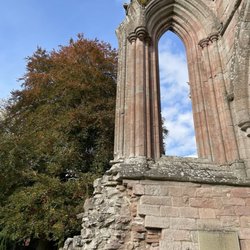
I wanted to visit at least one ruined abbey on my tour around Scotland; I chose Dryburgh mostly for…read morethe geography (an appropriate first stop on Day 1 out of Edinburgh) and as the burial place of Sir Walter Scott. However, when I walked onto the grounds, and the abbey came into view, I knew that I had made a perfect choice and a wonderful discovery. Sites like these are exactly why I love to visit Europe. On a Tuesday noon in late May, there were no other visitors, and the weather was splendid. At first, I had to restrain myself from rushing through too quickly, but later I sort of wandered around, or stood still, transfixed. Much of the structures are still standing, but many sections are mere outlines or foundations. Beyond admiring the sad beauty of their current condition, I imagined how the complex must have looked at its height in the 15th century. The impeccably maintained lawns made an effective frame or canvas against which to view the buildings. Of course, it wasn't like that during the time of the monks, but I liked the effect that the landscaping had, to sort of draw a contrast between the ancient and the modern, and heighten the sense of the abbey as a historical relic. Superficially, it just looked really pretty, like an upscale cemetery. Indeed, as I mentioned, Sir Walter Scott, as well as Field Marshal Douglas Haig and others, is buried here. The historical curiosity of Scott's burial place, while one of the main reasons for my visit, was pushed way into the background by the wonder of the abbey itself. For the historically curious, small plaques on the buildings tell you their purpose and era. The abbey had a turbulent history, thanks to its position near the Scottish-English border. It was founded in the 12th century, endured at least two cycles of destruction and rebuilding, and was finally abandoned after the violence of 1544. I spent about an hour wandering the grounds; climbing on the ruined walls; enjoying the beauty of the site, with the River Tweed to one side; and contemplating the monastic life that occurred there. Not to mention taking copious photographs.

What a beautiful, peaceful place…read more When I first walked in (we had a rather large group), I thought the place was kind of small and I was a little concerned that we'd be all crowded about in one area. Nope. Although a lot of the abbey is gone, it doesn't take much to think back as to how grand this place must have been when it was first built. The one standing rose window looked surreal and beautiful, surrounded by the ruins of other standing structures and crumbling rocks. There are detailed plaques describing each area of the abbey (one of my favorite descriptors was of the book cabinet built into the stone wall on the side, complete with slots for shelves!) as well as an artist's depiction of what the place looked like in its prime. The graveyard (as well as the yards) are impeccably manicured and there are plenty of spaces to get some wicked photos. I wish we'd had more time to wander about, especially in the back near the River Tweed and other areas nearby.

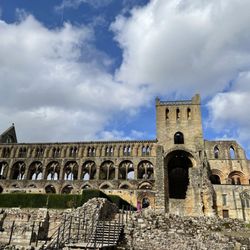
Jedburgh Abbey - There's a Raven up there if you look close

Jedburgh Abbey

(9 reviews)

We were told that only a small portion of the abbey would be closed due to hazardous conditions…read more Unfortunately, we were deceived as the entire chapel is closed. Save you pounds and go elsewhere.

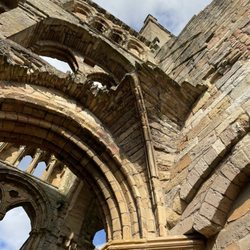
One of the four great Border abbeys it is well worth the £5.20 entrance fee. It feels haunting and…read moreimpressive and I, visiting alone, felt dwarfed, dominated, and in awe of what it must have looked like when complete. It was a Priory ordered by King David in 1138. Made from local stone, it took over 100 years to complete the abbey. On the South facing slopes of River Jed it is town centreish. There has been a church on this site since the 9th century. The Augustinian order took it over in the 11th century and the old church was replaced by the present wonderful building in the early 1200s. David built it to demonstrate to his own subjects - and to those in England - that he could create a magnificent building in the southernmost part of his kingdom. He allowed the monks to create the huge cross-shaped plan of nave, presbytery and transepts in a prominent position while the cloister, chapter house, cellars and other accommodation could be built on lower levels I think they were underground but nothing remains).. leaving the flowing arches of the nave to dominate the site. Standing to full height, and missing only its roof, the nave comprises a spectacle of richly moulded arches, elegant clustered columns topped with waterleaf capitals, and a continuous row of slender lancet windows forming the clerestory. A truly delightful aspect of Jedburgh Abbey is the reconstructed cloister garden, which has been designed and planted to give an impression of a typical monastery garden of the 1500s. During the border wars for Independance it was badly damaged and rebuilt many times. These Wars with the English drove the monks out by the end of the 13th century. The Abbey was reconstructed and again part destroyed several more times during the 14th, 15th and 16th centuries. Immediately after the damage inflicted by the English army at that time, Scotland went through a period of religious reformation which saw an end of the dominance of the Roman Catholic church - and all its symbols, including abbeys and monasteries. So Jedburgh and many other similar buildings were never rebuilt. However, it was used as a parish church. In the late 19th century, when a new parish church was built on the other side of the Jed Water, the Marquis of Lothian paid for major repairs to be carried out and when the great abbey was taken into State care in 1913, it was in better shape than many of its sister abbeys in the Borders. Despite these trials it is one of the best preserved of the Border abbeys. visitor centre has the priceless comb and other artifacts found. One thing I would say is this part of Scotland seems very cold. I went in October and was freezing. Wrap up warm.

Hopetoun Monument and Byres Hill

Hopetoun Monument and Byres Hill

(1 review)

You know something, Hopetoun Monument is everywhere you drive in East Lothian. It feels no matter…read morewhere you look, it's there. I didn't even know the name of the place until 2 weeks ago, but it is ever-present. What was it for? An ornate lookout post, a fancy dovecote? Well, I've climbed up Byres Hill, as well as the rickety stairs up to the top of Hopetoun and I can tell you now. It's a monument erected to the 4th Earl of Hopetoun. That 4th Earl, he must have been some dude, especially if you think about lugging up the bricks up that hill. To get to the monument, you have to find the blooming thing first - I eventually got there via Athelstaneford (if you are coming from Haddington), then having found it on my horizon, just kept following the roads until I stumbled across the car park. Let it be known, this place is not well signposted. Nor maintained. At least one path is too overgrown to try to navigate, so it's the steep up and down option for all. A soggy muddy path semi-overgrown up a steep incline means that for some, this will be an unsuccessful trip. The last few hundred metres are over rugged, rocky ground. By then, if you are like unhealthy me, you will be wheezing like a woman twice your age and wondering why you didn't go to the gym more often. But, once you get to the top, you are faced with the enormity of the monument (now now, no smutty puns), and the views that stretch from Fife over to the Lammermuir hills. It is a view like no other. If you are feeling brave, climb the 132 stairs (of varying quality) up to the top. There is a warning at the car park that you need a torch - in fairness, that instead of the sunglasses i was wearing would have been more useful, as small incisions into the wall left pockets of like for your eyes to grab hold of, but ultimately there were gaps of darkness where you just had to trust in yourself. Just as well, as my sunnies were prescription and unfortunately being blind as a bat still is only a metaphor in my case. But again, you are definitely rewarded for the burning thighs and the pressure in your chest because what you get when you are arrive is the final flourish. No trees, no nothing stand in your way and with realtively clear blue skies, there was almost no limit to what can be seen. There are placards at the top to give you an idea of what you are looking at, but for me, watching the shadows of clouds trail by on the fields below, staring out to Fife and to the Lomond Hills beyond, listening to the occasional noisy car far far far away, here is somewhere where you can find peace, both inner and outer.


Burgh Chambers - landmarks - Updated May 2026

Loading...
Loading...
Loading...