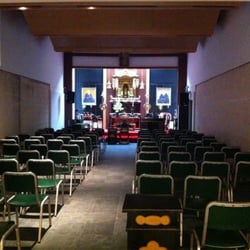
Short version: odd experience, some of which was within the temple's control and some was not. If…read morethis experience turned you off, do not allow it to define your experience of Zen or Buddhism, because this was a particular manifestation that made me rather uncomfortable and did not seem representative of the practice at large. Noticeable lack of diversity in the actual students, though the public crowd was more mixed. I guess the intentions are good though.
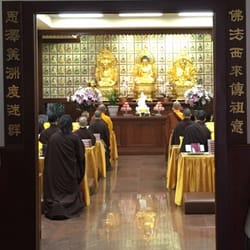
Liturgy and sutra chanting is done in English, which is an understandable choice - I guess you want folks to understand what they are chanting. But if you have ever been to a temple where chanting is done in one of the languages where the tradition of Buddhism first developed and flourished (i.e. i.e. Japanese/Chinese/Sanskrit), you'll notice that the syllabic and tonal structure of those languages creates a particularly beautiful aesthetic for chanting which is largely lost in English. The translations were also rather awkward and I found myself more focused on the lack of congruence in the whole situation than the actual content of the sutras, which is unfortunate.
A very helpful gentleman was walking up and down the aisle and making sure everyone was on the correct page, which was very considerate.
A lady next to me, who'd clearly been before as she had all the liturgies memorized, seemed to take particular pride and zeal in butchering the pronunciation of names when we were reading through the ancestor line. I get that foreign languages are difficult and that human speech patterns are largely set after childhood, and that there's no malice in mispronouncing something, but you'd think a little humility would be called for if you know you're about to pronounce something that you're likely to screw up. ¯\_(ツ)_/¯
Beginning instruction for zazen meditation was good. They provide you with pillows and cushions and introduce you to various poses. I thought the tone was appropriate and approachable for beginners.
However, I perceived the meditation leaders to be overly judgmental during the actual meditation session (which, given the foundational belief that all is simply a construction within your mind and judgement is one of the building blocks of suffering, is rather ironic). The instruction is to sit still, but inevitably people want to cough, or shift around, or scratch their nose. When this happened I would catch the leaders looking around or leaning slightly in one direction or another to see who the "culprit" was, and at some point one of them called out, in a particularly harsh tone, for people to sit still. The general seriousness and gravity with which parts of the ritual are carried out (such as the bringing in of the reading podium) seem to have missed the point that all is temporary. You'd think a funeral was happening here.
Lastly - and this is what really ruined the experience for me - my boyfriend had left his glasses on his cushion, and at some point during the walking meditation, they were broken. Again, there is a sad irony in the fact that something was carelessly broken during an exercise that was meant to be about mindfulness in walking - literally, feeling the movement of your foot, the placement on the ground, the shifting of balance, the movement of your joints, etc. I find it hard to believe that the breaking of a pair of glasses could have been missed in such a quiet, deliberate, concentrated exercise, and if someone was aware that it happened, I was profoundly disappointed by the fact that they simply left them there without claiming responsibility.
But - all is temporary, judgement causes pain, attachment is the root of all suffering. So I'll let go of the glasses, I'll let go of the awkward English sutra chanting, I'll let go of the fact that people looked waaaaaaay too serious, and I'll let go of this experience. :)