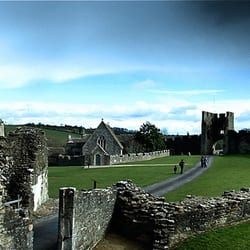
Farleigh Hungerford castle is an attractive but largely ruined castle set in the very picturesque…read morevalley of the River Frome, about 10 miles south east of Bath. It played an important role during the English Civil War.
History
The castle started life as a Manor House, the home of the Montfort family since the Norman invasion. In 1369 it was sold to Sir Thomas Hungerford, the first speaker of the House of Commons, who began work on the present castle.
This comprised a square-plan bailey, nearly 200ft across, enclosed by walls with a round tower at each corner, and a big gatehouse with projecting towers on the southern side. It contained a series of domestic buildings within, including a hall. The River Frome provided a natural protection to the east, and a moat surrounded the other three sides.
The castle was substantially enlarged with the addition of an outer bailey around 1425 by his son, Sir Walter Hungerford (also the first Lord Hungerford), and provided with a fine square gatehouse. The new fortifications also enclosed the parish church, which henceforth became the castle chapel: confusingly, both the chapel, and the parish church built by Sir Walter in 1443 to replace it, are dedicated to St Leonard. The one in the castle is known as the Chapel of St Leonard.
The Hungerford family was split between the opposing forces in the Civil War; the garrison of the castle was given to Colonel John Hungerford in 1644 but, a year later, he surrendered the castle without a fight to his half brother, Sir Edward Hungerford (1596-1648), who commanded the Parliamentary forces of Wiltshire.
Charles II was entertained at the castle in 1675 by the last of the Hungerfords, Sir Edward (1632-1711), who sold it in 1686. It became ruinous shortly thereafter. It is now in the care of English Heritage.
The site
The site is entered through the impressive gatehouse of the later fortifications; the walls either side are largely intact and include a semi-circular tower in the south side. Within, the remains are more scattered: of the original inner bailey, the south west tower is well preserved, and the south east tower stands to about half its original height: most of the rest consists of low walls and the outline of foundations, together with some of the original paved internal roadways. Nevertheless, it is possible to get a good picture of the size and scale of the original castle.
The Chapel of St Leonard, enclosed within its own walls in the outer bailey, is very well preserved. This consists of a mid 14th Century nave and chancel, to which the North or Hungerford Chapel was added around 1380, and a west porch in the 16th Century. Underneath the chapel is a vaulted crypt.
The chapel has a large painting of a knight dating from around 1440, and features German and Dutch stained glass from the 16th to 18th centuries. The family monuments are very impressive, and include those of Sir Thomas Hungerford (d. 1398) and his wife; Sir Walter Hungerford (d. 1596); Sir Edward Hungerford (d. 1607); Mrs Mary Shaw (d. 1613); and Sir Edward Hungerford (d. 1648) and his wife, executed with fine effigies, in black and white marble. Finally, the chapel crypt contains the best collection of human-shaped lead coffins in the country.
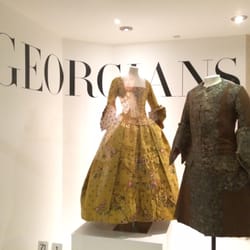
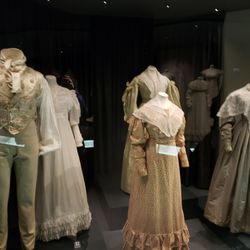
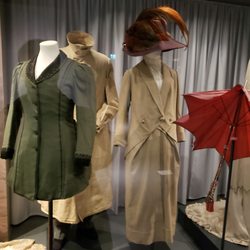
The site is well interpreted, with displays illustrating its history of the castle and its inhabitants, and an audio tour is available. It would make an excellent day out for families, walkers and those interested in history.
The castle is also an excellent starting point for relatively undemanding walks along the valley of the River Frome.
Practicalities
The castle is on the busy A366 just over 3 miles west of Trowbridge. The site includes a shop and provides limited refreshments, as well as toilets (including one with wheelchair access). Disabled parking on tarmac is 20m from the entrance.
Much of the site is level, albeit with a mixture of rough cobbles, paving, gravel and lawns. Wheelchair access is limited to the lawns of the outer bailey, although there is a chair lift to the Chapel. The upper level of the museum has a steep spiral staircase.
Entry (April 2010) is £3.80 (adults), £1.90 (children) and £3.20 (concessions). Free to English Heritage members.
The castle is open every day from 10am from April to the end of October, and Saturdays and Sundays only during the winter. Closing time varies from 4pm to 6pm depending on the time of the year.