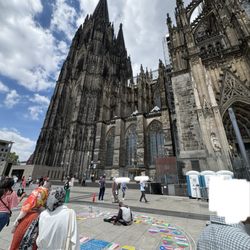
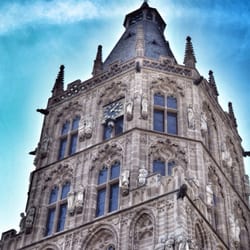
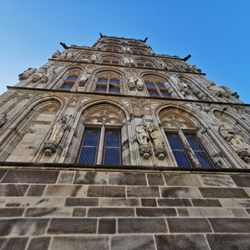
Also known as the Cologne Cathedral, this UNESCO World Heritage site took 632 years to complete…read morebetween 1248-1880 with a 370 year gap for a variety of reasons - Napoleonic War, etc. It took so long to build that the gothic cathedral's original 13th century plans which were 4m tall were lost mid-construction and had to be pieced together from notes drawn up in the interim. The stained glass on the north side were created in the middle ages which the stained glass on the south side were created in the 19th century. Nevertheless, the construction was so solid that while bombs from WWII blew out some windows (the medieval ones had already been taken down for safekeeping), the structure remained standing while everything around it had been near flattened.
A baptismal fount dating back to Roman times has been found outside the cathedral, which means that there has been a near continuous Christian services there, even when the building was not yet finished.
I remember studying AP art history and looking at paintings of people justaposed against cathedrals from the Romantic period and thinking, they must be exaggerating the scale between the two. Nope, they were not.
It is estimated that it takes EUR33,000/ day to maintain the Cathedral. Therefore, we entirely support the fact that it has begun charging admissions since earlier this year. You can see different parts of the exterior has been cleaned to a sparkling cream color. However, I imagine by the time one finishes cleaning the last part of the cathedral, it will be time to clean the parts that were first cleaned. It's that big. It is the 3rd largest spired cathedral in the world and the largest double spired cathedral. It is also the most visited attraction in Germany.
We climbed up the north spire. "No joke, no elevators" a signed warned. No kidding, Everything in this cathedral was carried up by hand (and foot!). All the additions, such as safety nets and safety cages had to be brought up through the stairs. All the equipment and materials for the renovations in the south spire have to be carried up the same way. We would all be in better shape if we had to do this several times a day.
We visited the Treasury, which was carved into the ground, at times abutting ruins of a Roman wall. A couple of the rooms date back to the earliest days of the cathedral's construction in the 13th century. A couple of tombs of Frankish nobles from the 6th century were uncovered in the 1950s and its contents documented and displayed. They are the 4th and 5th recorded tombs uncovered during the cathedral's construction. However, the first three were either relocated or lost/stolen without any proper record kept about them.
Two events were devastating to the Treasury. The first was the secularization in 1803 when nearly 70 ecclesiastical states and 45 free imperial cities were abolished and absorbed by secular princes to compensate them for territories lost to revolutionary France. Many items were lost during this period. The second was the 1975 heist in which three men scaled the cathedral's buttresses and entered the Treasury through a ventilation shaft. Once inside, they violently pried off gemstones. A two year operation saw the return of many of the gems, but the settings had to be painstakingly recreated by master goldsmiths.