I have visited other computer history collections, including the National Museum of American…read moreHistory in Washington, D.C. I also went to school learning to program on some of the types of computers displayed here and later worked in software engineering. So I came into the Computer History Museum with a bit of a "seen it, done it, why do it again?" attitude.
My husband and I ended up spending five hours here.
Does that make us nerds? Probably.
One of the highlights for me was the live IBM 1401 demonstration. When we visited, demonstrations were offered Wednesday at 3:00 p.m. and Saturday at 11:00 a.m. and 1:00 p.m. I even got to create my own punch card and have it used during the demonstration.
I'd learned about punched cards, but watching cards physically being fed into the IBM 1401 to program the computer was something I had never actually seen before. It made an important piece of computing history suddenly tangible.
There are also live demonstrations of the PDP-1 on the first and third Saturdays at 2:30 and 3:15 p.m., and a Spacewar! Tournament every fifth Saturday at noon. You may even get the chance to play Spacewar!, one of the earliest video games.
If you can attend a guided tour, I highly recommend it. Rather than simply walking past rows of old machines, the guide helped bring the history alive, including the ENIAC and the enormous changes in computer technology and chips over the decades.
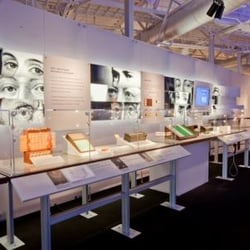
There is a replica of a World War II Enigma cipher machine on display, along with early census machines. The collection progresses through vintage computers such as UNIVAC, the IBM System/360, minicomputers and desktop computers, as well as the technology surrounding them: hard drives, mice, printers, computer chips and much more.
Eventually, you arrive in the age of artificial intelligence and Ameca, the AI-powered robotic head and shoulders. You're supposed to be able to speak with her using a microphone, although during our visit she didn't seem to be able to hear what anyone was saying into it.
There is also a café with coffee, other drinks, and grab-and-go food including sandwiches, hummus and pizza. There is seating both indoors and outside, which made it easy for us to take a break before continuing through the museum.
One parking warning: we visited on a Saturday when a Vintage Computer Festival was also taking place. By the time we arrived around 10:40 a.m., the museum parking was full. Parking attendants redirected us to a Microsoft visitor parking lot about 0.45 miles away, and there was no shuttle, so we had to walk between the lot and museum.
I expected this to be a relatively quick visit because I had already seen plenty of historic computers over the years.
Five hours later, I had created a punch card, watched an IBM 1401 come alive, revisited computers and technology from my own past, and discovered quite a few things I had never seen before.
Apparently, even for a couple of computer nerds, there was still plenty left to learn.